Comparison
We Compared 5 Popular Ways to Get Your Blood Sugar Back to Normal. Which One Is Currently #1?

Why Should You Get Your Blood Sugar Back to Normal?
New Study Shows Getting Blood Sugar Back to Normal May Cut Heart Disease Risk in Half
A recent analysis of two major diabetes-prevention studies found that people with prediabetes who returned to normal glucose levels had roughly half the long-term risk of cardiovascular death or hospitalization for heart failure compared with those who did not.
And these benefits didn’t appear six months later.
Researchers followed participants for 20—and in one study, 30—years.
But buried inside the findings was another number that may be even more important for anyone currently struggling with elevated blood sugar.
In the U.S. study, only 275 of 2,402 participants brought their blood sugar back into the normal range after the first year.
That’s just 11.5%.
The other 88.5% did not.
Which raises an obvious question:
If getting your blood sugar back to normal could make such a profound difference to your future health, why do so many people struggle to get there?
It certainly isn’t because there’s a shortage of advice.
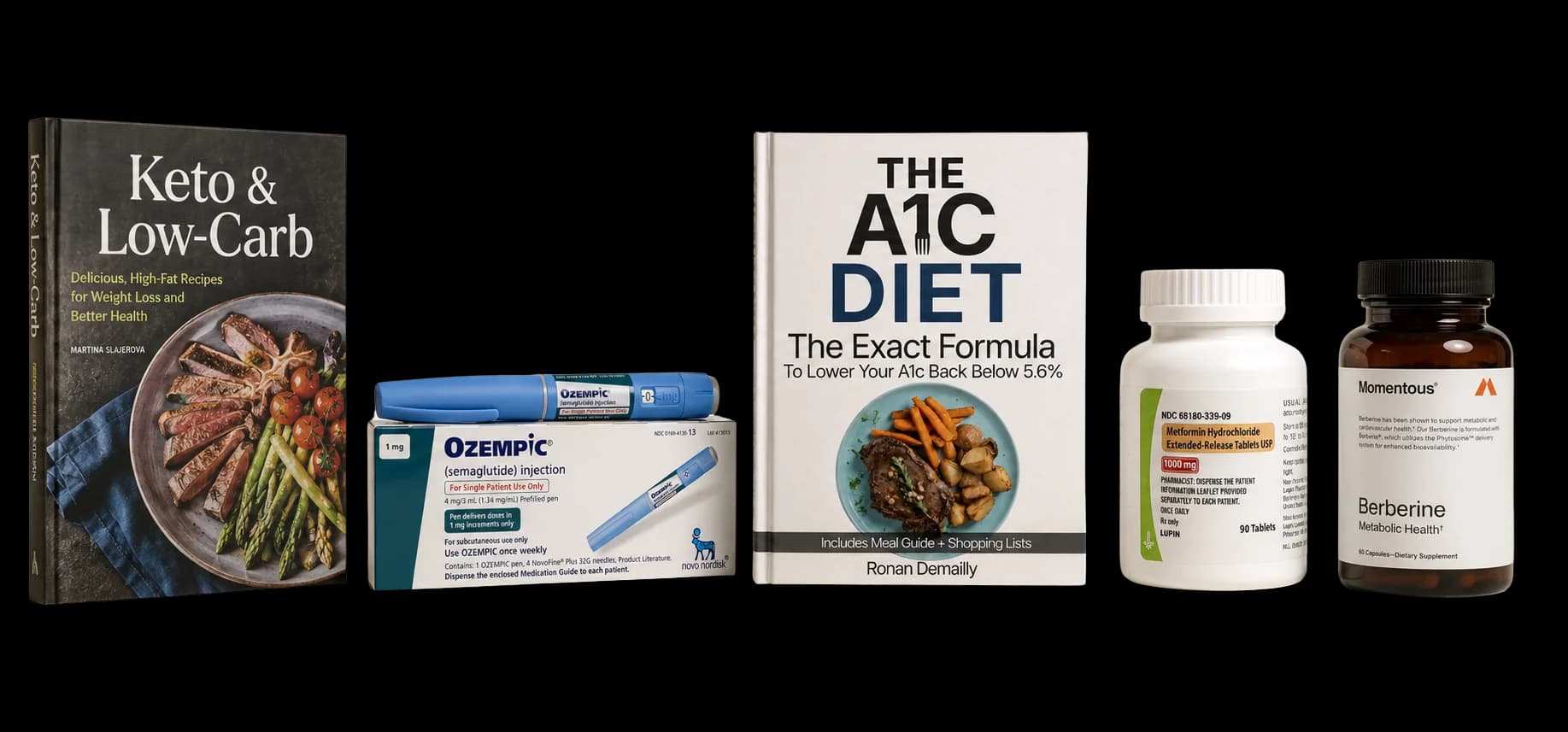
Depending on where you look, you may be told to take metformin, ask about Ozempic or Mounjaro, eliminate nearly every carbohydrate, try the latest blood sugar supplement—or completely change the way you eat.
But these approaches can differ enormously in cost, potential side effects, restrictions and how easily they fit into everyday life.
So we compared five of the most popular approaches:
- The A1C Diet
- Metformin
- GLP-1 medications
- Keto and low-carb diets
- Blood sugar supplements
We evaluated each one based on its potential to support healthier blood sugar, its practical limitations, its cost and accessibility, and—perhaps most importantly—whether someone could realistically continue using it long enough to see meaningful results.
Some approaches can be powerful but come with significant tradeoffs. Others sound simple until you try to fit them around restaurants, travel, family meals and everything else that happens in real life.
One offered the best overall combination of simplicity, flexibility and long-term practicality.
Here’s how all five compared.

#1 — The A1C Diet
Best overall for improving the way you eat without extreme restrictions or making food your full-time job
What it is
The A1C Diet is a simple, flexible way of eating designed to help you focus on the foods and habits that matter most for your blood sugar—while still leaving room for the foods you enjoy.
It isn’t keto. It isn’t zero-carb. It isn’t a cleanse or a fasting protocol. And it doesn’t give you a long list of foods you’re never allowed to eat again.
There are no special foods to buy, no complicated recipes to prepare every night and no need to make a completely different dinner while the rest of your family eats something else.
Most of the time, you follow a few simple principles for building your meals. You learn what to eat more often, what to eat less often and how to combine foods in a way that better supports your blood sugar.
But there’s also room built into the diet for real life.
Why it ranked #1
The A1C Diet stood out because it addresses the decision people with elevated blood sugar have to make several times every day:
“What am I supposed to eat?”
Metformin may help lower blood sugar. GLP-1 medications may help with blood sugar and weight. Keto may work as long as you can tolerate the restrictions.
But none of those approaches necessarily gives you a simple, sustainable way to handle breakfast, lunch, dinner, restaurants, vacations and family meals.
That’s where the A1C Diet is different.
You can still go out to dinner with your wife. You can still enjoy pizza with your family. You can still have pasta on vacation or cake at a birthday.
Then, at your next meal, you simply return to your normal way of eating.
No guilt. No punishment. No starving yourself the next day. And no deciding you’ve ruined the entire week and promising to start again Monday.
This makes the A1C Diet particularly useful for people who feel as though they’ve already tried everything.
Instead of asking you to become more disciplined, follow more rules or try harder, it helps you identify what matters most—and what you can stop worrying so much about.
The goal isn’t to eat perfectly for 30 days.
The goal is to build a way of eating you can still see yourself following six months from now.
And because it focuses on everyday food choices, the A1C Diet can also be followed alongside any treatment or medication recommended by your doctor.
Cost: A one-time purchase with no ongoing subscription.
Pros
- No calorie counting or complicated food tracking
- Doesn’t require keto, zero-carb eating or fasting
- Leaves room for restaurants, vacations and favorite foods
- No special foods, shakes or supplements required
- Can be followed alongside doctor-prescribed treatment
- Designed around long-term consistency rather than short-term perfection
- One-time cost with no monthly subscription
Cons
- You still have to apply the principles and make changes to the way you eat
- It isn’t a replacement for medical care or medication prescribed by your doctor

#2 — Metformin
Proven, affordable and widely used—but designed to manage blood sugar, not eliminate everything driving it
What it is
Metformin is one of the most commonly prescribed medications for type 2 diabetes. It helps the liver release less glucose and helps the body use insulin more effectively. Unlike insulin and certain other diabetes medications, metformin used by itself carries a relatively low risk of dangerously low blood sugar. (NIDDK)
Why it ranked #2
Metformin ranked highly because it has been used for decades, is available as an inexpensive generic and can meaningfully improve blood sugar for many people.
For someone whose numbers remain elevated despite making lifestyle changes, it may be an important—and sometimes necessary—part of their treatment.
But metformin has one important limitation:
It is primarily a blood sugar management tool—not a complete root-cause solution.
It can help bring the amount of glucose in your bloodstream down. But getting a better number on your next lab report doesn’t necessarily mean that all the underlying factors pushing your blood sugar up have been resolved.
Insulin resistance and elevated blood sugar can be influenced by several factors, including eating patterns, excess abdominal fat, physical inactivity, sleep, stress and genetics.
Metformin may help manage the glucose while you’re taking it, but it doesn’t automatically change those underlying drivers.
That’s why someone can take metformin every day, see an improvement in their numbers and still remain dependent on the medication to keep those numbers under control.
For people who aren’t simply interested in managing their blood sugar—but want to improve the conditions that caused it to rise in the first place—metformin may be one part of the plan.
But it usually isn’t the entire solution.
Cost: Generally inexpensive as a generic prescription; the exact price depends on dosage, pharmacy and insurance coverage.
Pros
- Established prescription treatment with decades of use
- Can meaningfully improve blood sugar
- Available as an inexpensive generic
- Taken by mouth rather than injected
- Low risk of hypoglycemia when used by itself
- May help some people lose a small amount of weight
Cons
- Primarily manages blood sugar rather than automatically resolving its underlying drivers
- May require continued use to maintain its glucose-lowering effect
- Digestive side effects are common, particularly when starting
- Requires a prescription and appropriate medical monitoring
- Longer-term use may lower vitamin B12 levels in some people
Overall verdict: Metformin can be a valuable part of a blood sugar treatment plan. But for someone who wants to do more than manage the number—and instead improve what is driving it—medication alone may not be enough.

#3 — GLP-1 Medications
Powerful—but the risks can be serious, and the results may create a dependence on continued treatment
What they are
GLP-1–based medications include drugs such as Ozempic and Mounjaro. They can lower blood sugar, suppress appetite and produce substantial weight loss.
But effectiveness doesn’t automatically make them the best long-term option for everyone.
Why they ranked #3
The biggest concern is the potential for side effects.
Nausea, vomiting, diarrhea, constipation and abdominal pain are common. But official FDA prescribing information also warns about less common, potentially serious problems—including pancreatitis, gallbladder disease, kidney injury related to dehydration and severe gastrointestinal reactions.
These complications don’t happen to everyone, and some are rare. But they are serious enough to appear in the medications’ official warnings and precautions. (FDA prescribing information)
There’s also a concern that receives far less attention:
Not all the weight lost is necessarily fat.
In a body-composition analysis from the STEP 1 semaglutide trial, participants lost substantial body fat—but their total lean body mass also decreased by 9.7%.
Lean mass isn’t exactly the same as muscle, but muscle makes up an important part of it. That matters particularly for adults over 50, when maintaining strength and muscle becomes increasingly important. (STEP 1 body-composition analysis)
Finally, there’s the question of dependence on continued treatment.
GLP-1 medications aren’t chemically addictive. But your results may depend on continuing to take them.
In a follow-up study, participants regained approximately two-thirds of the weight they had lost within one year of stopping semaglutide. Many of their previous cardiometabolic improvements also began moving back toward baseline. (PubMed)
In other words, the medication may work extremely well while you’re taking it.
But what happens when you stop?
For many people, maintaining the result may require staying on the medication long term—potentially for years—while continuing to manage the cost, side effects and availability.
Cost: Potentially expensive without insurance coverage; the amount paid varies considerably by medication, dosage and health plan.
Pros
- Can produce substantial improvements in blood sugar
- Often leads to significant weight loss
- May reduce hunger and make smaller portions easier
- Certain medications provide additional cardiovascular or kidney benefits for appropriate patients
Cons
- Common digestive side effects can be difficult to tolerate
- Official prescribing information includes several potentially serious risks
- Some of the weight lost may come from lean mass
- Weight and cardiometabolic improvements may reverse after treatment stops
- Maintaining the results may require long-term continued treatment
- Can be expensive or difficult to access without insurance coverage
- Requires a prescription and ongoing medical supervision
Overall verdict: GLP-1–based medications may be appropriate—and even highly beneficial—for certain patients under a doctor’s care. But the potential for serious side effects, loss of lean mass and dependence on continued treatment kept them from ranking higher.

#4 — Keto and Low-Carb Diets
Can lower blood sugar quickly—but only if you can live with the restrictions
What they are
Low-carb diets reduce foods such as bread, pasta, rice, potatoes, sweets and sugary drinks. Keto takes this considerably further, often limiting total carbohydrate intake to approximately 20–50 grams per day.
Because carbohydrates have the most immediate effect on blood sugar after eating, reducing them can improve glucose levels and help some people lose weight. The American Diabetes Association recognizes low-carbohydrate eating as one evidence-based option for people with prediabetes or diabetes. (ADA Standards of Care)
Why they ranked #4
For some people, keto works—and it can work quickly.
The problem is that it generally keeps working only as long as you can continue following it.
Giving up bread, pasta, rice, potatoes, desserts and many fruits may sound manageable when you’re highly motivated. It becomes harder when you’re eating at a restaurant, traveling, attending a birthday or sharing dinner with your family.
Suddenly, every meal requires another calculation.
How many carbohydrates are in this? Is this keto-friendly? Did I get kicked out of ketosis? Did I just ruin the entire week?
And when someone eventually eats one of the foods they’ve been avoiding, it can feel as though the diet is over.
That creates the same cycle many people already know too well:
Be perfect. Slip up. Feel guilty. Start again Monday.
There are also medical considerations. People using insulin or certain glucose-lowering medications may need their dosage adjusted when sharply reducing carbohydrates. For people taking SGLT2 inhibitors, FDA prescribing information identifies ketogenic diets as one potential trigger for ketoacidosis—a serious medical emergency. (FDA prescribing information)
Cost: No required program or prescription cost, although specialty keto products and higher-protein foods may increase the grocery bill.
Pros
- Can produce meaningful improvements in blood sugar
- Often reduces post-meal glucose spikes
- May support weight loss
- Doesn’t require a prescription
- Provides straightforward rules about what to avoid
Cons
- Strict versions eliminate many commonly enjoyed foods
- Can be difficult to maintain around restaurants, travel and family meals
- Often requires continued carbohydrate counting
- Can encourage an all-or-nothing relationship with food
- May require medication adjustments and medical supervision
- Blood sugar and weight improvements may be difficult to maintain if the diet is abandoned
Overall verdict: Keto can be effective for someone who genuinely enjoys eating that way and can maintain the restrictions. But for most people seeking a realistic long-term solution, it asks them to give up too much for too long.

#5 — Blood Sugar Supplements
A few may provide modest support—but weak evidence and aggressive marketing make this the least reliable option
What they are
Blood sugar supplements commonly contain ingredients such as cinnamon, chromium, berberine, bitter melon or combinations of several different herbs and minerals.
They’re usually marketed as a simple way to support insulin sensitivity, reduce glucose spikes or maintain healthier blood sugar—often without requiring major changes to the way you eat.
Why they ranked #5
To be fair, some supplements may help certain people.
The National Institutes of Health acknowledges weak evidence of possible benefits from ingredients such as cinnamon, chromium and berberine.
But “may help a little” is very different from “will get your blood sugar back to normal.”
According to the NIH, there still isn’t enough strong scientific evidence to conclude that any dietary supplement can reliably manage or prevent type 2 diabetes. (NIH)
The biggest problem is that the marketing frequently moves much faster than the research.
A small study involving one ingredient can quickly become an advertisement for an entirely different formula. A modest change in one blood sugar measurement becomes “advanced glucose support.” And carefully worded phrases can make a product sound far more proven than it actually is.
Unlike prescription medications, dietary supplements are not approved by the FDA for safety and effectiveness before being sold. In many cases, a company doesn’t have to prove that its finished product can lower A1C before putting it on the market. (FDA)
The FDA and FTC have even issued warning letters to companies that illegally marketed supplements with claims that they could treat, prevent or cure diabetes. (FDA warning letters)
And even when a supplement does produce a small improvement, it remains primarily a management tool.
It doesn’t automatically change the way you eat, reduce excess abdominal fat, build muscle, improve sleep or address the other factors that may be driving your blood sugar higher.
That’s how someone can spend month after month buying new bottles, trying new ingredients and waiting for a meaningful change that never comes.
Cost: Varies widely by product and usually becomes a recurring monthly expense.
Pros
- Easy to take
- Doesn’t usually require a prescription
- Certain ingredients may provide modest benefits for some people
- May be useful as an addition to a broader plan when selected carefully
Cons
- Evidence is limited and inconsistent
- Most products have not been clinically tested as complete formulas
- Finished products don’t require FDA approval for effectiveness before being sold
- Marketing claims may reach far beyond the available research
- Ingredient quality and dosage can vary considerably between products
- May interact with medications or cause unwanted side effects
- Doesn’t address the underlying lifestyle factors driving elevated blood sugar
- Often creates another recurring monthly expense
Overall verdict: A carefully selected supplement may provide additional support for some people. But as a stand-alone strategy for getting blood sugar back to normal, it is the least reliable option in this comparison.
A supplement should supplement the plan. It should never become the plan.
Final Word
All five approaches may play a role in improving blood sugar.
But they don’t all offer the same balance of effectiveness, safety, affordability and long-term practicality.
Metformin can help manage glucose, but medication alone may not resolve the underlying factors driving it. GLP-1 medications can produce powerful results, but those results may come with serious side effects, loss of lean mass and dependence on continued treatment.
Keto can lower blood sugar, but only if you can continue living with the restrictions. And while a small number of supplements may provide modest support, the evidence behind most products remains inconsistent.
The A1C Diet stood out because of what it doesn’t require.
It doesn’t require injections. It doesn’t require a cabinet full of supplements. It doesn’t eliminate every carbohydrate you enjoy. And it doesn’t ask you to eat perfectly for the rest of your life.
Instead, it addresses something you have to deal with several times every day:
The way you eat.
You learn which foods and meal combinations matter most, which things you can stop worrying so much about and how to make better choices without organizing your entire life around blood sugar.
And because the approach is flexible, it can be followed alongside whatever treatment your doctor has recommended.
The A1C Diet didn’t rank #1 because it promises the most dramatic overnight result.
It ranked #1 because it offers a realistic way to improve your eating that you may still be able to follow six months—and even six years—from now.
The research we started with followed people for decades.
While nobody can tell you exactly what your health will look like 20 years from now, the findings offer an important reminder:
What you do about your blood sugar today may continue to matter for years to come.
You don’t have to fix everything overnight.
You simply need to know where to start.
Take the Free 1-Minute A1C Diet Quiz
Answer a few quick questions and see whether the A1C Diet may be right for you.
Try The A1C Diet System Risk Free
“Essential program for anyone struggling to lower A1C on their own with discipline and consistency alone”

God Send. Changed my life in profound ways! I HIGHLY recommend it. I was on so many meds I don’t want to name them all. At least 5 different ones. Through Ronans kind and incredibly factual info I was able to change my eating habits to the point that I got off all meds and drastically lowered my A1C.
“Grateful I found out before it was too late”

I was super stuck and heading for a life of pain if not death. I’ve lost 55lbs, and I now have a path to better health. I was provided the resources I needed, the guidance and the support. Out of all the bro-health, Ronan set himself apart by being real.. Using real information instead of bro-science. I’m forever thankful to have found Ronan.
This article is for general information only and is not medical advice. It is not intended to diagnose, treat, cure or prevent any disease. Always speak with your doctor before making changes to your diet, exercise or medications, and never stop or adjust a prescribed medication without medical supervision.
Results may vary from person to person. Testimonials reflect individual experiences and are not a guarantee that you will achieve the same outcome.