Food & Metabolism
How Much Fiber Do You Actually Need — and What Happens When You Don't Get Enough?
Fiber does far more than keep you regular. Different types can influence cholesterol, digestion, fullness, and the microbes living in your gut.
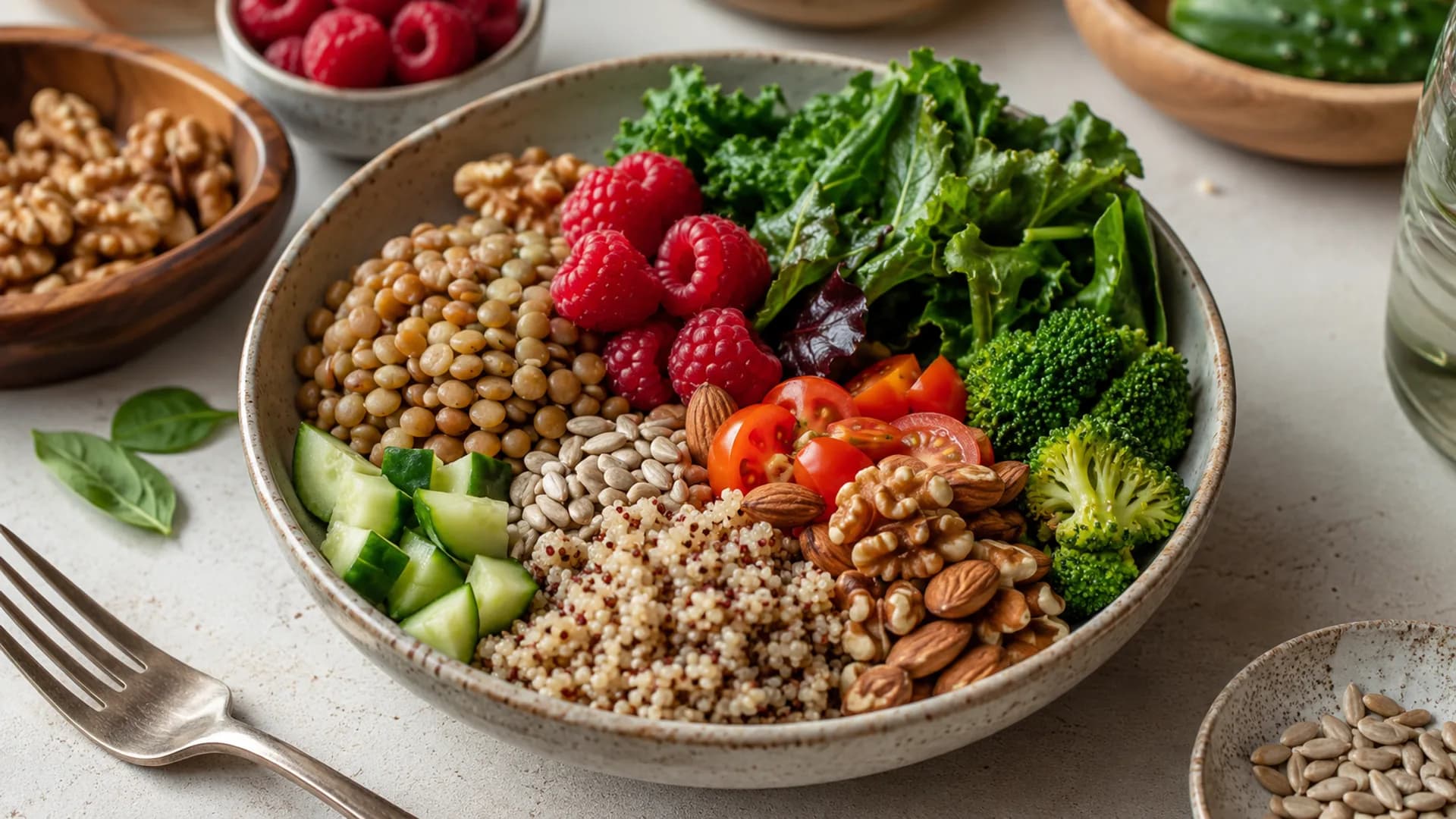
Fiber is often reduced to:
“It keeps you regular.”
That's true.
But different fibers can also influence:
- LDL cholesterol
- fullness
- digestion
- the gut microbiome
How much do adults need?
For adults over 50, U.S. Adequate Intake targets are:
Men 51+ 30 grams per day
Women 51+ 21 grams per day
The Nutrition Facts label uses:
28 grams per day
as the Daily Value on a 2,000-calorie diet.
Fiber is not one substance
Different fibers behave differently.
Some:
- dissolve in water
- form viscous gels
- are fermented by gut bacteria
Others:
- hold water
- add stool bulk
- pass through more intact
That is why oat fiber, wheat bran, and psyllium do not produce identical effects.
Soluble viscous fiber can lower LDL
Certain fibers from:
- oats
- barley
- psyllium
increase loss of bile acids.
The liver then uses cholesterol to make replacements and can remove more LDL from the blood.
A 2023 meta-analysis of:
181 randomized trials
with more than 14,500 participants found soluble-fiber supplementation lowered LDL by about:
8 mg/dL
on average.
Each additional 5 grams per day of soluble fiber was associated with further LDL reduction.
Fiber also helps constipation
A systematic review involving:
1,251 adults with chronic constipation
found about:
66%
responded to fiber treatment versus about:
41%
in control groups.
Psyllium had particularly useful evidence.
But more fiber also produced more gas.
Increase gradually
Going from 10 grams per day to 40 overnight can produce:
- bloating
- gas
- cramping
Particularly fermentable fibers give intestinal bacteria much more substrate to process.
Increase intake gradually and drink adequate fluid, especially when using bulking fibers such as psyllium.
Gut microbes use fiber you cannot digest
Some fibers reach the colon and are fermented into:
short-chain fatty acids
including:
- acetate
- propionate
- butyrate
Butyrate can be used as fuel by cells lining the colon.
This is one reason fiber is important to gut-microbiome research.
But there is no single perfect “microbiome fiber.”
Variety matters.
Long-term health data are impressive
A major Lancet analysis included:
185 prospective studies
plus:
58 clinical trials.
Higher fiber intake was associated with roughly:
15–30% lower risk
across outcomes including:
- all-cause mortality
- cardiovascular disease
- stroke
- colorectal cancer
The strongest overall patterns appeared around:
25–29 grams per day.
Much of this evidence is observational.
Fiber-rich diets also contain more:
- whole grains
- beans
- vegetables
- fruit
- nuts
So fiber is partly a marker of an entire dietary pattern.
Get the research, without the noise.
Practical, sourced writing on blood sugar and metabolic health. One email a week.
One email a week. Unsubscribe any time. See our privacy policy.
What does low fiber look like?
A day based mostly on:
- eggs
- cheese
- meat
- white bread
- white rice
can contain plenty of food while providing very little fiber.
Now add:
- oatmeal
- berries
- beans
- vegetables
- a pear
- nuts
and the daily total changes quickly.
A cup of many cooked beans or lentils can provide roughly:
12–16 grams.
A cup of raspberries can provide around:
8 grams.
The Health Facts takeaway
For many adults, roughly:
25–30 grams of fiber per day
is a useful practical target, with official recommendations varying by age and sex.
You do not need to memorize fiber chemistry.
Simply eat more:
- legumes
- vegetables
- whole fruit
- whole grains
- nuts
- seeds
Increase gradually.
Because fiber's benefits reach much further than:
the bathroom.
Sources
- 1. National Academies. Dietary Reference Intakes for Fiber.
- 2. Reynolds A, et al. Carbohydrate Quality and Human Health: A Series of Systematic Reviews and Meta-Analyses. The Lancet, 2019. doi:10.1016/S0140-6736(18)31809-9
- 3. Ghavami A, et al. Soluble Fiber Supplementation and Serum Lipid Profile: A Systematic Review and Dose-Response Meta-Analysis of Randomized Controlled Trials. Advances in Nutrition, 2023. doi:10.1016/j.advnut.2023.01.005
- 4. van der Schoot A, et al. The Effect of Fiber Supplementation on Chronic Constipation in Adults: An Updated Systematic Review and Meta-Analysis of Randomized Controlled Trials. American Journal of Clinical Nutrition, 2022. doi:10.1093/ajcn/nqac184
- 5. U.S. FDA. Dietary Fiber — Nutrition Facts Label.
Comments
No comments yet.
Leave a comment
Comments are moderated. Be kind and stay on topic.
Related articles
Carbs Aren't All the Same: Why 40 Grams From Beans Is Different From 40 Grams From White Bread
Protein, Fat and Fiber: What They Actually Do to Your Blood Sugar After a Meal

Are Eggs Actually Bad for Your Cholesterol? What the Evidence Says Now