Food & Metabolism
Carbs Aren't All the Same: Why 40 Grams From Beans Is Different From 40 Grams From White Bread
Two foods can contain the same carbohydrate amount and still produce very different glucose responses. Fiber, structure, resistant starch and processing change how fast it arrives.
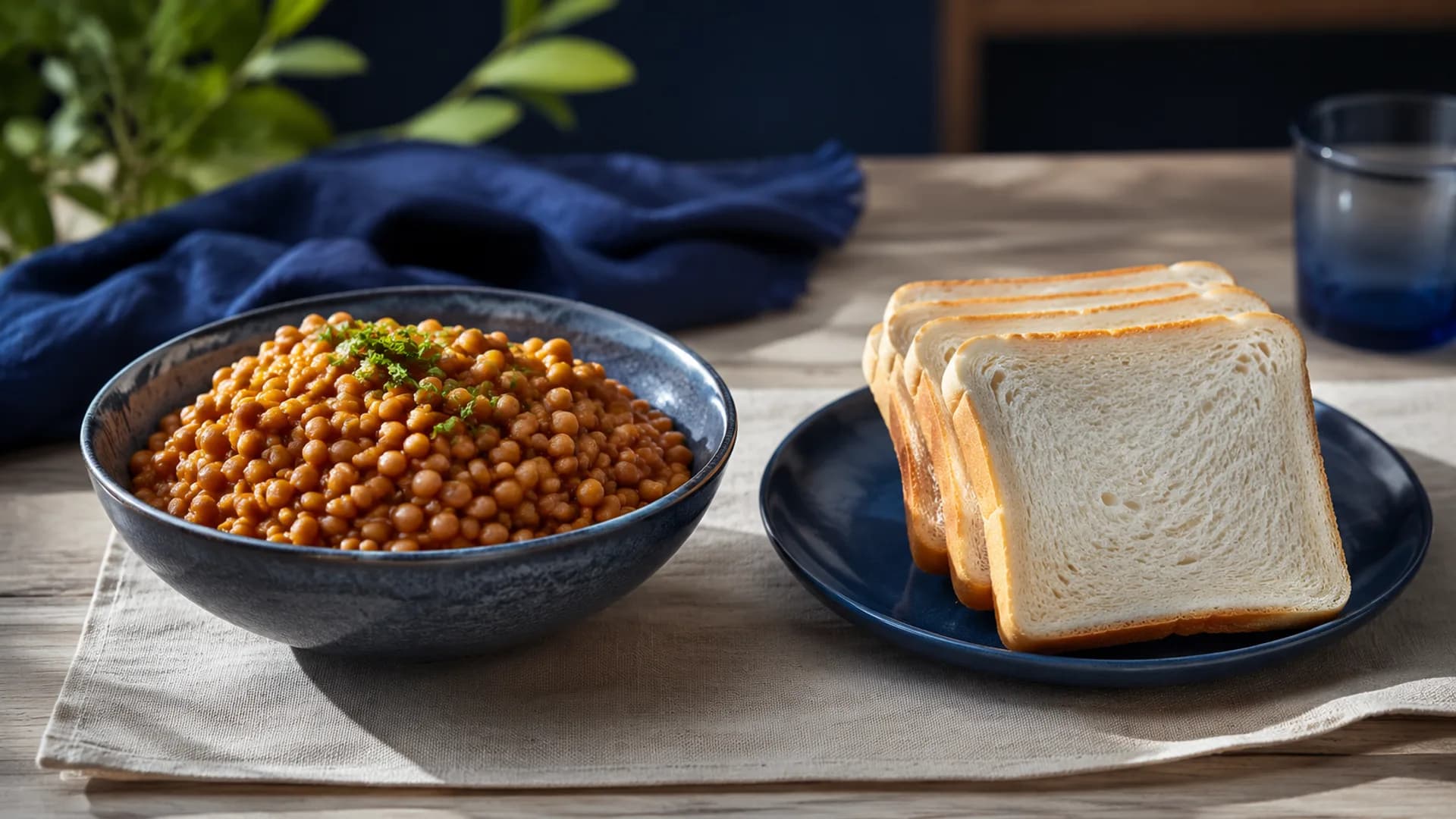
Suppose two meals both contain:
40 grams of carbohydrate.
One comes from white bread.
The other comes from beans.
If carbohydrate were the only thing that mattered, you might expect roughly the same blood sugar response.
But that's not necessarily what happens.
In controlled experiments where researchers gave people the same amount of carbohydrate from different foods, glucose responses sometimes differed dramatically.
The reason is simple:
Your body doesn't eat "40 grams of carbs."
It eats food.
And the structure of that food changes what happens next.
The carbohydrate number doesn't tell you how quickly it arrives
After you eat carbohydrate, digestive enzymes break much of it down into sugars that can eventually enter your bloodstream.
But that process can happen:
very quickly
or
much more slowly.
Compare a slice of white bread with a kidney bean.
White bread has been:
- milled into fine flour
- mixed
- baked
- structurally broken down before you ever chew it
Much of its starch is readily accessible to digestive enzymes.
A bean is different.
Its carbohydrate remains packaged inside a relatively intact plant structure containing:
- fiber
- protein
- resistant starch
- cell walls
Your digestive system has more work to do before all of that carbohydrate becomes available.
That changes the glucose curve.
Researchers saw this even when the carbohydrate amount was held constant
In an early controlled experiment, people with diabetes were given portions of different foods containing 50 grams of carbohydrate.
The carbohydrate amount was deliberately kept the same.
Yet the glucose responses were not.
Across the legumes tested, researchers found that the average:
peak rise in glucose was 23% lower
and the:
overall glucose response was 28% lower
than the average response to the other starchy foods tested.
Those foods included breads, rice, potatoes, oatmeal, spaghetti, and cornflakes.
So:
same carbohydrate dose
did not equal
same glucose response.
That observation became part of the scientific foundation for what we now call the glycemic index.
Glycemic index asks a different question than carbohydrate grams
Carbohydrate amount asks:
How much carbohydrate is in this food?
Glycemic index asks:
How rapidly and strongly does a fixed amount of available carbohydrate from this food raise blood glucose?
The standard scale uses glucose or another reference food as the comparison.
Very broadly:
| Glycemic Index | Classification |
|---|---|
| 55 or lower | Low GI |
| 56–69 | Medium GI |
| 70 or higher | High GI |
Legumes such as:
- beans
- lentils
- chickpeas
tend to fall toward the lower end of the glycemic-index spectrum.
Many refined breads and cereals are considerably higher.
But the reason is more interesting than the number itself.
Fiber changes how carbohydrate is delivered
Beans contain substantial dietary fiber.
Fiber is counted as carbohydrate on U.S. Nutrition Facts labels, but most dietary fiber is not digested into glucose in the same way as starch or sugar.
That's an important distinction.
Suppose a food label says:
40 g total carbohydrate
and includes:
12 g fiber.
That is metabolically different from another food containing:
40 g total carbohydrate
with:
1 g fiber.
This is why comparing foods based only on the total-carbohydrate line can be misleading.
Fiber can also alter:
- digestion
- gastric emptying
- glucose absorption
- gut hormone responses
The 2026 American Diabetes Association Standards specifically recommend emphasizing minimally processed, nutrient-dense, high-fiber carbohydrate sources, including legumes, whole fruits, vegetables, and whole grains.
Some starch isn't digested normally either
Not all starch behaves identically.
Some is known as:
resistant starch.
As the name suggests, resistant starch resists digestion in the small intestine.
Instead of being rapidly broken down into glucose, some reaches the large intestine where it can be fermented by gut bacteria.
Legumes naturally contain resistant starch.
A 2023 systematic review of 36 randomized controlled trials involving 982 people with type 2 diabetes or prediabetes found that certain types of resistant starch reduced post-meal glucose responses compared with more rapidly digestible starches.
That doesn't mean resistant starch makes carbohydrate disappear.
It means the chemical and physical form of starch influences how the body handles it.
The food's physical structure matters
This may be one of the most overlooked parts of nutrition.
Imagine eating:
intact wheat berries
versus
wheat flour.
They can come from the exact same plant.
But grinding the grain destroys much of its original physical structure.
That gives digestive enzymes easier access to the starch.
Researchers tested this in adults with type 2 diabetes by feeding them whole-grain foods that contained similar nutrients but differed in how finely they had been processed.
There were 31 participants, with 28 completing both interventions.
When participants ate the less-processed whole grains, their post-meal glucose response was:
9% lower after breakfast
and approximately:
6% lower across all meals
compared with the more finely milled versions.
Same general grain.
Similar nutrient composition.
Different physical structure.
Different glucose response.
That tells us something important:
Food structure is part of nutrition.
"Whole grain" doesn't automatically guarantee a small glucose response
There is an important nuance here.
People sometimes assume:
White flour = high glucose
Whole-wheat flour = low glucose
It isn't always that simple.
Once wheat has been finely milled into flour, even whole-wheat flour can be digested relatively quickly.
A randomized crossover trial comparing carefully matched whole-grain and refined wheat products found no meaningful difference in acute glycemic response when particle size, viscosity, and food form were matched.
Likewise, a systematic review found that finely ground wholemeal wheat did not consistently produce a significantly smaller glucose response than refined wheat.
That's worth remembering.
The word "whole" on a package does not automatically tell you what the glucose curve will look like.
How much the grain has been physically processed matters too.
Beans bring protein with the carbohydrate
Beans aren't simply packages of starch.
They also provide plant protein.
For example, a serving of beans may contain meaningful amounts of:
- carbohydrate
- fiber
- protein
White bread is typically much more dominated by rapidly available starch.
Protein can alter the digestive and hormonal response to a mixed meal.
So even if two foods provide a similar amount of digestible carbohydrate, the entire metabolic environment surrounding that carbohydrate may be different.
This is one reason nutrition labels shouldn't be interpreted as if nutrients enter the body independently.
They arrive together as a meal.
Chickpeas versus white bread provides a striking example
Researchers have directly compared chickpeas with white bread while matching their available carbohydrate.
That last part matters.
They weren't simply giving people less carbohydrate from the chickpeas.
In the experiment, chickpeas produced blood glucose concentrations approximately:
29–36% lower
than white bread.
The study was relatively small and involved healthy women, so it shouldn't be treated as a universal prediction for someone with type 2 diabetes.
But it demonstrates the principle clearly:
Even when available carbohydrate is matched, the food source can substantially change the response.
What happens when people eat more legumes for months?
Acute glucose spikes are interesting.
But A1C matters more over the long term.
In a randomized trial, researchers assigned 121 adults with type 2 diabetes to one of two dietary strategies for three months.
One group was encouraged to consume at least:
1 cup of legumes per day.
The comparison group increased insoluble fiber primarily through whole-wheat foods.
A1C fell in both groups.
But the legume-focused, lower-glycemic-index diet reduced A1C by approximately:
0.5 percentage points
compared with:
0.3 percentage points
in the whole-wheat-fiber group.
The between-group advantage was about:
0.2 percentage points.
The legume group also experienced a greater reduction in systolic blood pressure.
That doesn't prove beans have a magical glucose-lowering property.
The intervention changed an entire dietary pattern.
But it supports the broader point that the quality and form of carbohydrate matter in addition to the amount.
So does carbohydrate quantity still matter?
Absolutely.
This article should not be interpreted as:
"Carb quantity doesn't matter as long as the carbs are healthy."
That's also wrong.
Imagine eating:
½ cup of beans
versus:
4 cups of beans.
The second meal contains substantially more carbohydrate and energy.
Even a low-GI food can produce a meaningful glucose rise if the carbohydrate load is large enough.
That's why another concept exists:
glycemic load.
Glycemic load combines:
how glycemic a food is
with:
how much carbohydrate you actually eat.
That distinction is useful because nobody eats standardized laboratory portions in real life.
You eat meals.
Get the research, without the noise.
Practical, sourced writing on blood sugar and metabolic health. One email a week.
One email a week. Unsubscribe any time. See our privacy policy.
This is why "net carbs" can also become misleading
Some people try to solve the problem by calculating:
total carbohydrate − fiber = net carbs.
That can be a useful shorthand in certain situations.
But it still isn't a perfect prediction of glucose response.
Why?
Because two foods with the same calculated "net carbs" can still differ in:
- starch structure
- processing
- particle size
- cooking method
- resistant starch
- protein
- fat
- food matrix
And as we saw in Why Two People Can Eat the Same Meal and Get Completely Different Blood Sugar Responses, the person eating the food matters too.
So there is no arithmetic formula on a nutrition label that can perfectly predict everyone's glucose curve.
A better way to think about carbohydrate
Instead of asking only:
"How many carbs?"
ask four questions.
How much?
Total quantity still matters.
What source?
Beans are not metabolically identical to white bread.
Whole fruit is not identical to fruit juice.
Steel-cut oats are not identical to sugary breakfast cereal.
How processed?
The more completely a food's physical structure has been broken down, the easier its starch may be for digestive enzymes to access.
What is it being eaten with?
Protein, fat, fiber, vegetables, meal sequence, and the rest of the meal can all influence the final response.
That is a much more useful framework than:
Carbs are bad.
or:
Carbs are fine.
Both statements are too simple.
The Health Facts takeaway
Nutrition labels make carbohydrate look like one substance.
It isn't.
40 grams from beans and 40 grams from white bread may look identical on a carbohydrate counter.
But your digestive system sees two very different packages.
Beans bring:
- fiber
- resistant starch
- protein
- intact plant structure
- slower-accessible carbohydrate
White bread generally presents starch in a much more rapidly accessible form.
That's why equal carbohydrate amounts can produce different glucose curves.
It also explains why the 2026 ADA Standards don't simply tell people with diabetes:
"Avoid carbohydrates."
Instead, the guidelines emphasize carbohydrate quality, recommending minimally processed, nutrient-dense, high-fiber sources while minimizing refined grains and highly processed foods.
For blood sugar, quantity matters.
But so do:
quality
structure
processing
portion
and
the person eating it.
So the better question isn't:
"How many carbs does this have?"
It's:
"What kind of carbohydrate is this, how much am I eating, and how well does my body handle it?"
That gives you a much more useful picture of what the meal is actually doing.
Sources
- 1. American Diabetes Association Professional Practice Committee. Facilitating Positive Health Behaviors and Well-being to Improve Health Outcomes: Standards of Care in Diabetes—2026. Diabetes Care, 2026.
- 2. Jenkins DJA, Wolever TMS, Jenkins AL, et al. The Glycaemic Index of Foods Tested in Diabetic Patients: A New Basis for Carbohydrate Exchange Favouring the Use of Legumes. Diabetologia, 1983.
- 3. Jenkins DJA, Kendall CWC, Augustin LSA, et al. Effect of Legumes as Part of a Low Glycemic Index Diet on Glycemic Control and Cardiovascular Risk Factors in Type 2 Diabetes Mellitus: A Randomized Controlled Trial. Archives of Internal Medicine, 2012. doi:10.1001/2013.jamainternmed.70
- 4. Papakonstantinou E, et al. Chickpeas Suppress Postprandial Blood Glucose Concentration, and Appetite and Reduce Energy Intake at the Next Meal. Appetite, 2017.
- 5. Åberg S, et al. Whole-Grain Processing and Glycemic Control in Type 2 Diabetes: A Randomized Crossover Trial. Diabetes Care, 2020.
- 6. Xiong K, Wang J, Kang T, Xu F, Ma A. Effects of Resistant Starch on Glycaemic Control: A Systematic Review and Meta-analysis. British Journal of Nutrition, 2021. doi:10.1017/S0007114520003700
- 7. Bielefeld D, Grafenauer S, Rangan A. The Effects of Legume Consumption on Markers of Glycaemic Control in Individuals With and Without Diabetes Mellitus: A Systematic Literature Review of Randomised Controlled Trials. Nutrients, 2020.
- 8. Musa-Veloso K, Poon T, Harkness LS, O'Shea M, Chu YF. The Effects of Whole-Grain Compared With Refined Wheat, Rice, and Rye on the Postprandial Blood Glucose Response: A Systematic Review and Meta-analysis of Randomized Controlled Trials. American Journal of Clinical Nutrition, 2018.
Comments
No comments yet.
Leave a comment
Comments are moderated. Be kind and stay on topic.
Related articles
Protein, Fat and Fiber: What They Actually Do to Your Blood Sugar After a Meal

Why Two People Can Eat the Same Meal and Get Completely Different Blood Sugar Responses
Why Ultra-Processed Food Isn't the Same Thing as Simply 'Eating Carbs'