Food & Metabolism
Protein, Fat and Fiber: What They Actually Do to Your Blood Sugar After a Meal
Carbohydrate drives much of the immediate glucose rise, but protein, fat and fiber change how quickly glucose appears, how much insulin is released, and what follows hours later.
Most blood sugar advice focuses on one thing:
carbohydrates.
And there is a good reason for that.
Carbohydrate has the most direct effect on post-meal glucose.
But here's where nutrition gets more interesting:
You almost never eat carbohydrate in isolation.
You eat meals.
And adding protein, fat, or fiber can change:
- how quickly food leaves your stomach
- how rapidly glucose reaches your bloodstream
- how much insulin is released
- how full you feel
- and sometimes what your glucose does several hours later
So two meals can contain the same amount of carbohydrate...
and still produce very different glucose curves.
Protein can lower the immediate glucose rise — while increasing insulin
Protein doesn't usually produce the same immediate glucose rise as carbohydrate.
But it is not metabolically inactive.
Certain amino acids stimulate the pancreas to release insulin.
Protein can also stimulate gut hormones involved in digestion and insulin secretion.
That can change what happens when protein is eaten alongside carbohydrate.
In one randomized crossover trial, 15 adults with type 2 diabetes consumed a high-glycemic breakfast on two occasions.
Before one meal, they drank water.
Before the other, they consumed 50 grams of whey protein.
With the whey preload:
- the overall post-meal glucose response was 28% lower
- the insulin response was 105% higher
- early insulin release was 96% higher
The researchers also observed substantial increases in GLP-1, one of the gut hormones involved in glucose-dependent insulin secretion.
That's an important lesson:
A lower glucose spike does not necessarily mean less insulin was required.
Sometimes glucose is lower precisely because more insulin was released sooner.
Protein can also slow the arrival of glucose
The effect isn't only about insulin.
Protein consumed before or with a meal can also influence gastric emptying — how quickly food leaves the stomach and enters the small intestine.
Slower gastric emptying generally means glucose arrives in the bloodstream more gradually.
A 12-week randomized trial studied 79 people with type 2 diabetes.
Participants received either:
- a preload containing 17 g whey protein + 5 g guar fiber
- or a placebo
before two meals each day.
The whey/fiber preload slowed gastric emptying and reduced post-meal glucose.
After 12 weeks, A1C was about:
0.1 percentage point lower
in the preload group than in the placebo group.
That's a modest difference — not a miracle intervention.
But it demonstrates that what surrounds the carbohydrate can change the glucose response.
Fiber works differently
Fiber is technically classified as carbohydrate.
But much of it is not digested into glucose in the small intestine.
That is why:
40 grams of total carbohydrate with 12 grams of fiber
is metabolically different from:
40 grams of carbohydrate with almost no fiber.
Fiber can influence glucose in several ways.
Depending on the type, it can:
- slow digestion
- increase viscosity inside the intestine
- reduce the speed of glucose absorption
- increase fullness
- alter fermentation in the colon
This is one reason current American Diabetes Association guidance recommends emphasizing minimally processed, high-fiber carbohydrate sources and aiming for at least:
14 grams of fiber per 1,000 calories
for people with diabetes or at risk for diabetes.
Not all fiber does the same thing
The word "fiber" covers several substances with different properties.
For blood sugar, soluble and viscous fibers can be particularly interesting because they can form a gel-like environment inside the digestive tract.
That may slow:
- gastric emptying
- carbohydrate digestion
- glucose absorption
Examples of foods containing meaningful soluble fiber include:
- beans
- lentils
- oats
- barley
- certain fruits
- psyllium
But adding a tiny amount of isolated fiber to a highly refined product does not automatically make it metabolically equivalent to an intact whole food.
Again:
the food matrix matters.
Fat can flatten the early spike — but there's a catch
Fat is where things become especially easy to misunderstand.
Adding fat to carbohydrate can slow gastric emptying.
That means the glucose from the carbohydrate may enter circulation more slowly.
So the early glucose peak can sometimes look smaller.
This has led to a common internet conclusion:
"Add fat to carbs and the glucose spike disappears."
That's incomplete.
The glucose may simply be arriving later.
In a controlled study involving people with and without type 2 diabetes, researchers compared glucose alone with a mixed meal containing glucose, fat, and protein.
The mixed meal produced a smaller immediate glucose excursion.
But researchers also observed:
- slower gastric emptying
- altered insulin secretion
- altered glucagon
- greater incretin hormone responses
In other words, the body wasn't simply "blocking" the carbohydrate.
The entire digestive and hormonal response had changed.
High-fat meals can produce delayed glucose problems
This is especially important for people using mealtime insulin.
The 2026 ADA Standards specifically note that fat and protein can affect both early and delayed post-meal glucose.
A high-fat mixed meal may produce:
smaller rise early
followed by:
more prolonged glucose elevation later.
For someone checking glucose only one hour after eating, the meal may look excellent.
But three or four hours later, the story can change.
That's why the ADA recommends that people using insulin be educated about the effect of fat and protein on delayed glucose — rather than dosing entirely from carbohydrate alone.
This is a useful reminder for everyone:
The highest point on the glucose curve isn't the only thing that matters.
Duration matters too.
A flat glucose curve doesn't automatically make a meal healthier
Here's a simple example.
Imagine:
Meal A
White bread alone.
Glucose rises quickly.
Now imagine:
Meal B
White bread covered in a very large amount of butter.
The added fat may slow digestion and flatten the early rise.
Does that automatically make Meal B healthier?
Of course not.
You also changed:
- calories
- saturated fat
- energy density
- digestion
- the later glucose response
The ADA recommends limiting foods high in saturated fat to reduce cardiovascular risk in people with diabetes.
So optimizing nutrition purely around the smallest immediate glucose spike can lead you in the wrong direction.
Blood sugar matters.
But it isn't the only health outcome that matters.
Protein + fiber can work especially well before carbohydrate
Another interesting area of research is meal sequence.
Instead of changing the foods, researchers simply change the order.
In one randomized crossover study, 15 people with prediabetes ate the same meal three different ways.
When participants ate protein and vegetables before the carbohydrate portion, the peak glucose rise was reduced by more than:
40%
compared with eating the carbohydrate first.
The total post-meal glucose exposure was about:
39% lower.
Same foods.
Same overall meal.
Different order.
That doesn't mean everyone must spend dinner eating food groups separately.
But it reinforces the larger point:
The metabolic effect of a meal depends on more than its carbohydrate total.
Get the research, without the noise.
Practical, sourced writing on blood sugar and metabolic health. One email a week.
One email a week. Unsubscribe any time. See our privacy policy.
So should you add protein, fat and fiber to every carbohydrate?
Not blindly.
That interpretation would miss the point.
Adding:
500 calories of cheese
to a bowl of pasta may reduce the early glucose spike...
while substantially increasing the meal's energy and saturated fat.
Adding:
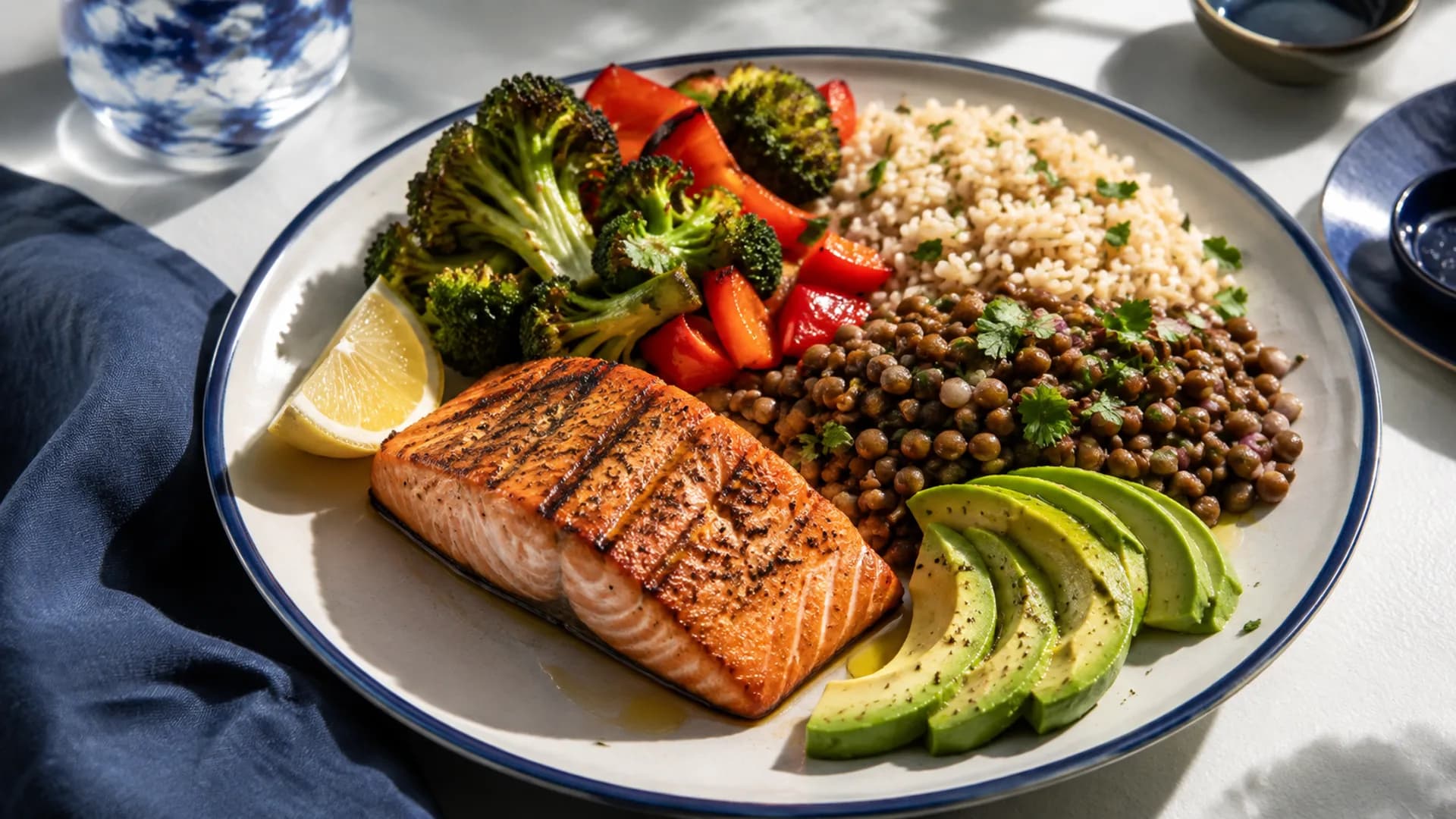
vegetables, lentils, lean protein, or a modest amount of unsaturated fat
creates a very different nutritional package.
The goal isn't simply:
"Make the CGM line flatter."
A better objective is:
Build a meal that delivers nutrients and energy in a way your metabolism can handle well.
A practical way to build the meal
Instead of thinking:
"How can I eliminate all carbohydrate?"
try building around four pieces.
Protein
Examples:
- fish
- chicken
- eggs
- Greek yogurt
- tofu
- legumes
Protein can improve satiety and can modify the insulin and glucose response to a mixed meal.
Fiber-rich plants
Examples:
- nonstarchy vegetables
- beans
- lentils
- berries
- intact whole grains
These add fiber and generally slow the delivery of carbohydrate.
Appropriate carbohydrate portion
Examples:
- beans
- potatoes
- rice
- whole grains
- fruit
Quantity still matters.
Mostly unsaturated fats
Examples:
- olive oil
- avocado
- nuts
- seeds
- fatty fish
These can contribute to satiety and cardiovascular health without relying heavily on saturated fat.
The proportions don't need to be identical for everyone.
That's why current diabetes nutrition guidelines emphasize individualized meal patterns rather than one ideal macronutrient ratio.
The Health Facts takeaway
Carbohydrates are important for understanding post-meal glucose.
But they don't act alone.
Protein can stimulate insulin and alter gut hormones.
Fiber can slow carbohydrate digestion and absorption.
Fat can slow gastric emptying and flatten the early response — while sometimes pushing glucose later.
And when these nutrients arrive together, the final glucose curve reflects the interaction between all of them.
That's why asking:
"How many carbs are in this?"
is useful...
but incomplete.
A better question is:
"What does the entire meal look like?"
For someone trying to improve A1C, that distinction can make eating much less restrictive.
You don't necessarily have to remove every carbohydrate-containing food.
Sometimes changing:
- the portion
- the source
- what you eat with it
- or even the order of the meal
can change what happens afterward.
The goal isn't to make food complicated.
It's the opposite.
Build meals your metabolism has an easier time handling.
Sources
- 1. American Diabetes Association Professional Practice Committee. Facilitating Positive Health Behaviors and Well-being to Improve Health Outcomes: Standards of Care in Diabetes—2026. Diabetes Care, 2026.
- 2. Jakubowicz D, Froy O, Ahrén B, et al. Incretin, Insulinotropic and Glucose-Lowering Effects of Whey Protein Pre-load in Type 2 Diabetes: A Randomised Clinical Trial. Diabetologia, 2014. doi:10.1007/s00125-014-3305-x
- 3. Watson LE, Phillips LK, Wu T, et al. A Whey/Guar “Preload” Improves Postprandial Glycaemia and Glycated Haemoglobin Levels in Type 2 Diabetes: A 12-Week Randomized Placebo-Controlled Trial. Diabetes, Obesity and Metabolism, 2019. doi:10.1111/dom.13604
- 4. Alsalim W, Tura A, Pacini G, et al. Mixed Meal Ingestion Diminishes Glucose Excursion in Comparison With Glucose Ingestion via Several Adaptive Mechanisms in People With and Without Type 2 Diabetes. Diabetes, Obesity and Metabolism, 2016. doi:10.1111/dom.12570
- 5. Shukla AP, Andono J, Touhamy SH, et al. The Impact of Food Order on Postprandial Glycaemic Excursions in Prediabetes. Diabetes, Obesity and Metabolism, 2019. doi:10.1111/dom.13503
- 6. Reynolds AN, Akerman AP, Mann J. Dietary Fibre and Whole Grains in Diabetes Management: Systematic Review and Meta-analyses. PLOS Medicine, 2020.
Comments
No comments yet.
Leave a comment
Comments are moderated. Be kind and stay on topic.
Related articles
Carbs Aren't All the Same: Why 40 Grams From Beans Is Different From 40 Grams From White Bread

Why Two People Can Eat the Same Meal and Get Completely Different Blood Sugar Responses

Why Ultra-Processed Food Isn't the Same Thing as Simply 'Eating Carbs'