Food & Metabolism
Is Olive Oil Really That Healthy? Here's What the Research Shows
Olive oil is rich in unsaturated fat, and extra-virgin varieties also contain polyphenols. The strongest evidence supports using it to replace less favorable fats.
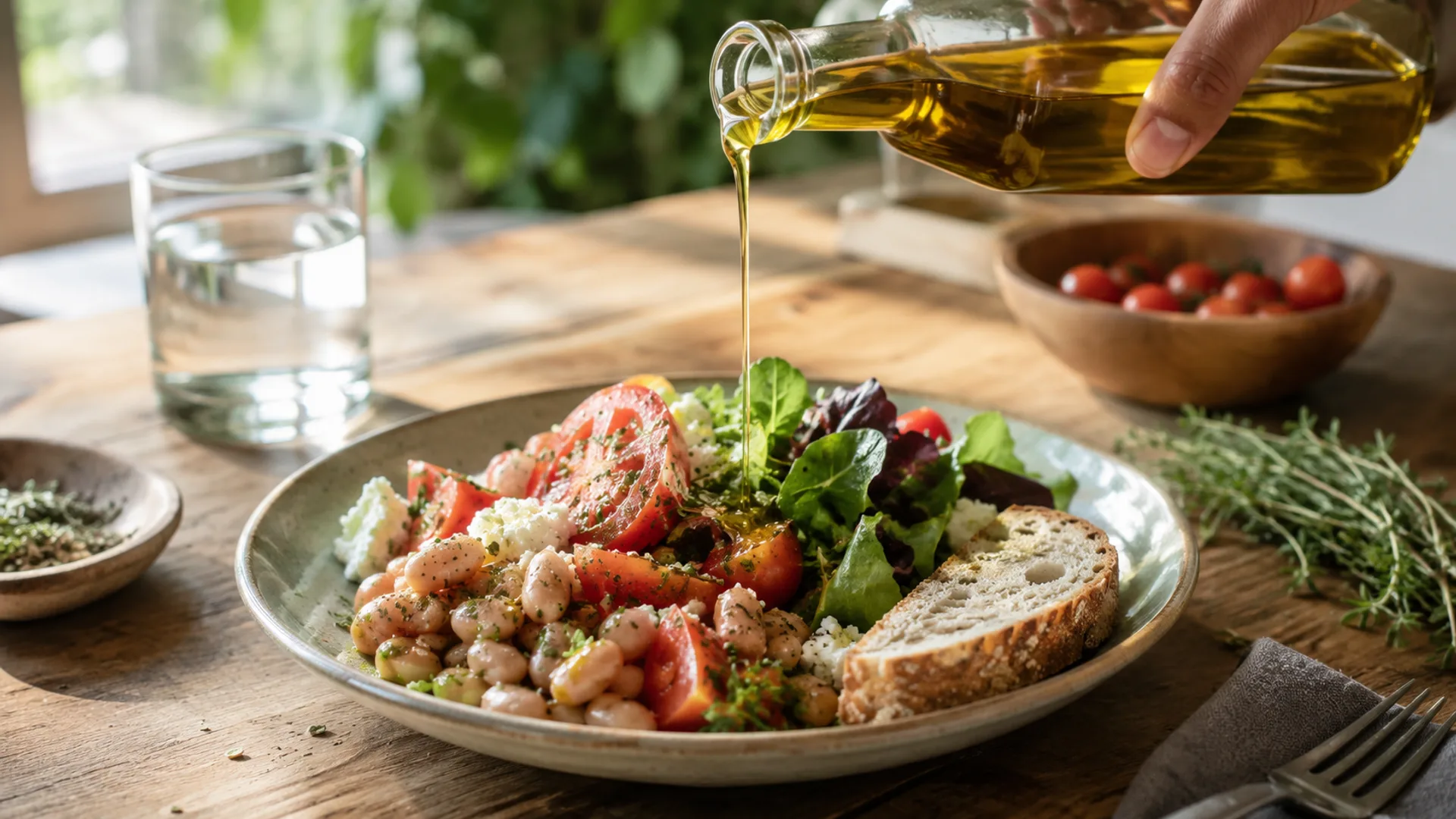
Olive oil has two reputations.
One says:
“It's one of the healthiest foods on earth.”
The other says:
“It's pure fat and calories.”
Both contain some truth.
One tablespoon contains roughly:
120 calories
and almost all of them come from fat.
But the type of fat matters.
Olive oil is rich in monounsaturated fat
The dominant fatty acid is:
oleic acid.
Replacing saturated fat with unsaturated fat can lower LDL cholesterol.
So if olive oil replaces:
butter
the intervention is not simply “adding oil.”
It is changing the type of fat in the diet.
More than 90,000 Americans were followed for decades
A large U.S. cohort analysis included more than:
92,000 adults
followed for up to 28 years.
People consuming more olive oil had lower all-cause and cardiovascular mortality.
The most interesting finding came from substitution analyses.
Replacing:
- butter
- margarine
- mayonnaise
- dairy fat
with olive oil was associated with lower mortality.
Replacing other vegetable oils with olive oil did not show the same clear advantage.
That suggests the strongest message is:
olive oil is especially useful when it replaces less favorable fats.
The PREDIMED trial added randomized evidence
PREDIMED enrolled:
7,447 adults
at high cardiovascular risk.
Participants were randomized to:
- Mediterranean diet + extra-virgin olive oil
- Mediterranean diet + nuts
- control advice to reduce fat
During roughly five years of follow-up, the Mediterranean diet with extra-virgin olive oil produced fewer major cardiovascular events than the control group.
But PREDIMED did not test olive oil alone.
It tested an entire:
Mediterranean dietary pattern.
That included more:
- vegetables
- legumes
- fish
- nuts
- minimally processed foods
So we should not attribute the entire benefit to the oil bottle.
Extra-virgin olive oil contains more polyphenols
Extra-virgin olive oil undergoes less refining and retains more naturally occurring plant compounds such as:
- hydroxytyrosol
- tyrosol
- other phenolics
Randomized EUROLIVE studies found that higher-polyphenol olive oils improved several markers related to:
LDL oxidation.
These were mechanistic outcomes, not heart attacks.
But they provide a plausible biological reason extra-virgin oil may offer advantages beyond its fatty-acid profile.
Olive oil is still calorie-dense
This should not disappear from the discussion.
Four tablespoons contain roughly:
480 calories.
If you add that to your existing diet without replacing anything, total energy intake rises.
“Healthy fat” does not mean:
calorie-free fat.
Get the research, without the noise.
Practical, sourced writing on blood sugar and metabolic health. One email a week.
One email a week. Unsubscribe any time. See our privacy policy.
Can you cook with extra-virgin olive oil?
Yes.
The claim that heating olive oil instantly makes it toxic is exaggerated.
Extra-virgin olive oil is suitable for ordinary:
- sautéing
- baking
- roasting
As with any oil, repeatedly overheating it until it smokes heavily or reusing degraded frying oil is not ideal.
The Health Facts takeaway
Olive oil has one of the stronger evidence bases among dietary fats.
The best-supported pattern is:
replace saturated-fat-rich foods
with:
olive oil and other unsaturated plant fats
inside a diet rich in whole plant foods.
Extra-virgin olive oil adds flavor and more naturally occurring polyphenols.
What the evidence does not support is:
“The more olive oil you pour on food, the healthier it becomes.”
Use it as a replacement, not a health supplement.
Sources
- 1. Estruch R, et al. Primary Prevention of Cardiovascular Disease With a Mediterranean Diet Supplemented With Extra-Virgin Olive Oil or Nuts. New England Journal of Medicine, 2018. doi:10.1056/NEJMoa1800389
- 2. Guasch-Ferré M, et al. Consumption of Olive Oil and Risk of Total and Cause-Specific Mortality Among U.S. Adults. JACC, 2022. doi:10.1016/j.jacc.2021.10.041
- 3. Covas MI, et al. The Effect of Polyphenols in Olive Oil on Heart Disease Risk Factors: A Randomized Trial. Annals of Internal Medicine, 2006. doi:10.7326/0003-4819-145-5-200609050-00006
- 4. Hernáez Á, et al. Olive Oil Polyphenols Decrease LDL Concentrations and LDL Atherogenicity in Men in a Randomized Controlled Trial. Journal of Nutrition, 2015. doi:10.3945/jn.115.211557
Comments
No comments yet.
Leave a comment
Comments are moderated. Be kind and stay on topic.