Food & Metabolism
Why Ultra-Processed Food Isn't the Same Thing as Simply 'Eating Carbs'
Beans, berries, soda and packaged snack cakes all contain carbohydrate, but they are not metabolically equivalent. Processing changes far more than the number on the label.
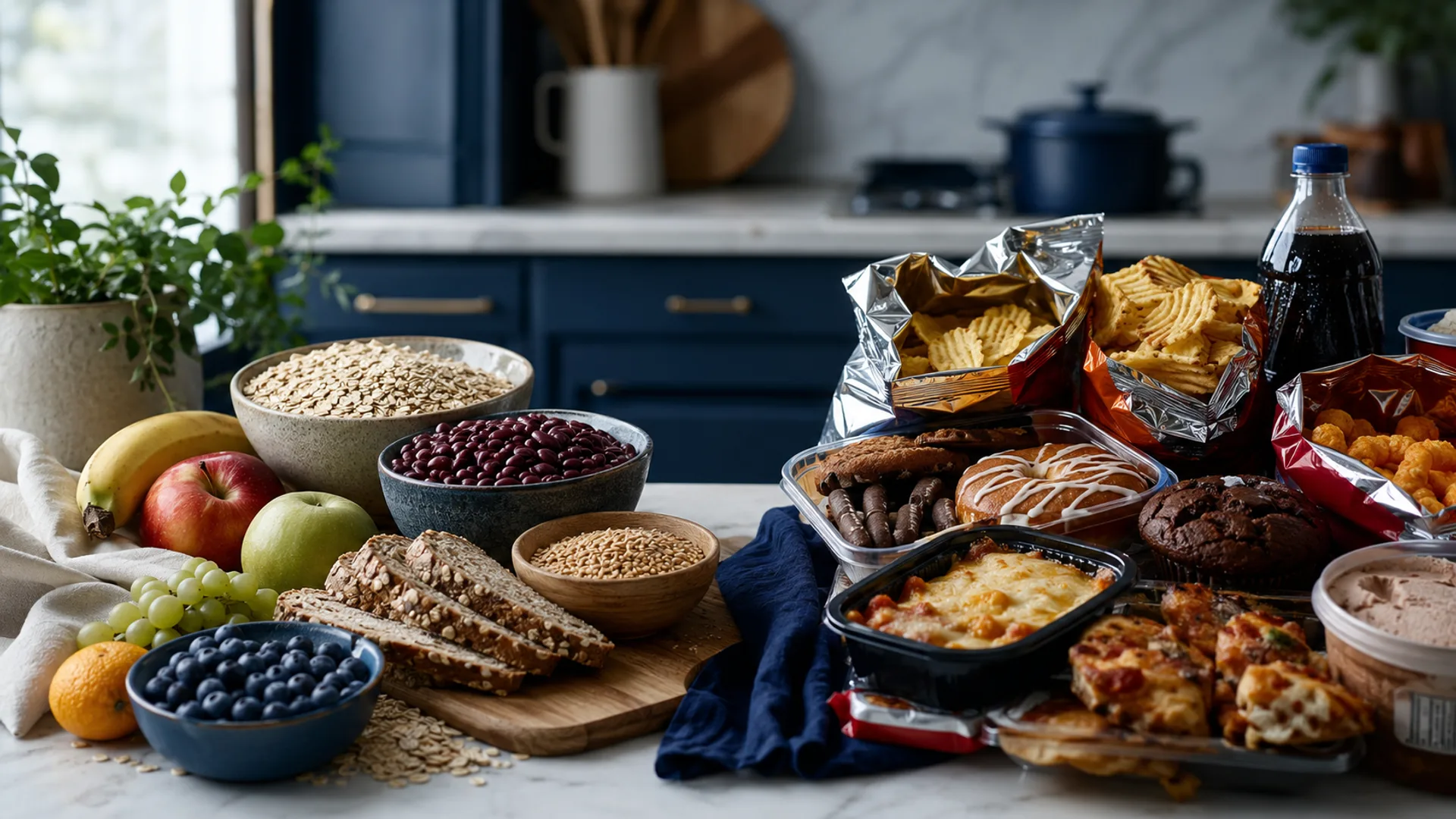
When people try to improve their blood sugar, they often reduce the entire problem to one word:
Carbs.
But consider these foods:
- lentils
- blueberries
- oatmeal
- soda
- packaged cookies
They all contain carbohydrate.
Yet putting them into one metabolic category doesn't make much sense.
Now consider:
- packaged processed meats
- artificially sweetened drinks
- certain low-carb snack products
Some may contain relatively little carbohydrate...
and still qualify as ultra-processed foods.
That's because:
"High carb" and "ultra-processed" describe two different things.
One describes nutrients.
The other describes what happened to the food before you ate it.
What does "ultra-processed" actually mean?
Researchers commonly classify foods using a system called NOVA.
NOVA separates foods according to the nature and purpose of their processing.
At one end are foods that are unprocessed or minimally processed:
- vegetables
- fruit
- eggs
- meat
- milk
- beans
- intact grains
At the other end are ultra-processed foods.
These are typically industrial formulations containing combinations of ingredients and additives that you would rarely use to prepare the same food in a home kitchen.
Examples can include:
- soft drinks
- packaged snack foods
- many confectionery products
- instant noodles
- some ready-made meals
- certain sweetened breakfast cereals
- many packaged desserts
Common ingredients may include things such as:
- modified starches
- protein isolates
- flavorings
- colors
- emulsifiers
- sweeteners
- hydrogenated or interesterified oils
The important point is that NOVA is not classifying foods by carbohydrate content.
A food can be:
high-carb and minimally processed
or:
low-carb and ultra-processed.
The NIH ran an unusually revealing experiment
Much of nutrition research is observational.
Researchers ask thousands of people what they eat and then follow them for years.
That is useful, but it makes cause and effect difficult to establish.
In 2019, researchers at the National Institutes of Health did something different.
They admitted:
20 adults
to the NIH Clinical Center and controlled essentially everything they ate.
Each participant spent:
two weeks eating an ultra-processed diet
and:
two weeks eating a minimally processed diet.
The meals offered in the two diets were designed to be matched for:
- calories
- carbohydrate
- fat
- protein
- sugar
- sodium
- fiber
Then researchers told participants:
Eat as much or as little as you want.
What happened was striking.
They ate about 500 more calories per day
During the ultra-processed diet, participants consumed an average of:
508 additional calories per day.
Not because researchers intentionally gave them more calories.
Participants simply chose to eat more.
During the ultra-processed phase, they gained approximately:
0.9 kg — about 2 pounds — in two weeks.
During the minimally processed phase, they lost approximately:
0.9 kg.
The direction reversed when the diet reversed.
This was a small, short study, so it cannot tell us exactly what would happen to everyone over years.
But it demonstrated something important under tightly controlled conditions:
Food processing may influence how much people spontaneously eat, even when the foods offered are designed to look similar on a basic nutrition panel.
So why did people eat more?
Researchers still don't have one complete answer.
Several possibilities are being investigated.
Ultra-processed foods can be eaten faster
In the NIH study, participants consumed the ultra-processed meals at a faster rate.
That matters because the body does not generate fullness signals instantaneously.
If you can consume more calories before those signals catch up, total intake may rise.
Think about the difference between eating:
an apple
and:
applesauce or an apple-flavored snack product.
The nutrient label may share similarities.
The physical eating experience can be completely different.
Food structure has been broken down for you
We've already seen this with carbohydrate.
In Carbs Aren't All the Same, we looked at why intact beans can produce a different glucose response from finely processed bread even when carbohydrate intake is controlled.
Food structure affects:
- chewing
- digestion
- enzyme access
- absorption speed
Industrial processing can substantially alter that structure.
So a carbohydrate doesn't enter your digestive system as an abstract molecule on a nutrition label.
It arrives inside a physical food matrix.
That matrix matters.
Ultra-processed foods often combine several rewarding properties
Many ultra-processed foods combine:
refined starch or sugar
with:
fat
plus:
salt, flavorings, or other ingredients.
Foods such as:
- pizza
- cookies
- chips
- pastries
- ice cream
aren't simply "carbs."
They're combinations designed to be extremely easy and pleasurable to consume.
That's different from eating:
plain boiled potatoes
or:
a bowl of lentils.
Reducing the distinction to carbohydrate grams misses much of what is happening.
Calorie density can become easy to underestimate
Whole and minimally processed foods often contain considerable:
- water
- fiber
- physical volume
Ultra-processed products can package substantial energy into relatively small portions.
That isn't universally true.
But it can make it easier to consume more calories before feeling physically full.
And over time, chronic excess energy intake can contribute to:
- weight gain
- visceral fat accumulation
- liver fat
- worsening insulin resistance
which can then make glucose increasingly difficult to control.
What does this have to do with type 2 diabetes?
Large prospective studies have repeatedly found that people consuming more ultra-processed food tend to develop type 2 diabetes more often.
A recent dose-response meta-analysis combined:
12 prospective cohort studies.
People in the highest ultra-processed-food category had approximately:
48% higher relative risk of developing type 2 diabetes
than people in the lowest category.
And for every 10 percentage-point increase in the proportion of food consumed as ultra-processed food, diabetes risk was approximately:
14% higher.
Observational studies cannot prove that ultra-processed food itself caused every additional case.
People who consume more ultra-processed food may differ in many other ways.
But the association has appeared repeatedly across populations.
One European study followed more than 300,000 people
A large analysis of the European Prospective Investigation into Cancer and Nutrition included:
311,892 adults
followed for an average of:
10.9 years.
During that period:
14,236 people developed type 2 diabetes.
Every 10-percentage-point increase in the proportion of food consumed as ultra-processed food was associated with approximately:
17% higher risk of developing type 2 diabetes.
Replacing ultra-processed foods with minimally processed or processed foods was associated with lower risk.
That's a substantial dataset.
But it also revealed something important:
Not every ultra-processed food behaved the same way
This is where the story becomes more nuanced.
Some ultra-processed food categories were strongly associated with greater diabetes risk.
Others were not.
And in some studies, certain products classified as ultra-processed were actually associated with lower risk.
A large U.S. analysis found higher diabetes risk particularly with categories such as:
- sugar-sweetened beverages
- artificially sweetened beverages
- refined breads
- some animal-based processed products
- ready-to-eat mixed dishes
But certain:
- whole-grain breads
- cereals
- yogurt-based products
were associated with lower risk.
A recent European analysis found similar heterogeneity.
So it would be scientifically sloppy to say:
"Everything classified as ultra-processed is toxic."
The category contains very different foods.
That's one limitation of the ultra-processed label
NOVA is useful because it forces researchers to consider something nutrition science ignored for years:
the degree and purpose of food processing.
But the classification isn't perfect.
It can place nutritionally different foods into the same broad category.
For example, depending on ingredients and classification method, an industrially produced:
whole-grain bread
and:
sugar-sweetened soda
may both receive the ultra-processed label.
Their nutritional profiles are obviously not identical.
Researchers continue debating how much of the observed health risk comes from:
- processing itself
- excessive calorie intake
- low fiber
- refined carbohydrate
- added fat
- sodium
- additives
- displacement of nutritious foods
- or combinations of these factors
The correct conclusion isn't:
"Processing doesn't matter."
Nor is it:
"Any food touched by a factory is dangerous."
The evidence is more nuanced.
Get the research, without the noise.
Practical, sourced writing on blood sugar and metabolic health. One email a week.
One email a week. Unsubscribe any time. See our privacy policy.
This is why "just cut carbs" can point you in the wrong direction
Imagine someone trying to improve blood sugar removes:
- lentils
- beans
- whole fruit
- oats
because:
"They have too many carbs."
Then replaces them with:
- packaged meat snacks
- processed low-carb bars
- low-carb desserts
- heavily formulated convenience foods
Their carbohydrate intake may fall.
But did their overall diet necessarily improve?
Not automatically.
Meanwhile, another person might eat:
- beans
- vegetables
- berries
- nuts
- minimally processed protein
- some intact whole grains
and consume more total carbohydrate...
while eating dramatically less ultra-processed food.
That's why carbohydrate quantity and food quality need to be evaluated separately.
The ADA now makes almost exactly this distinction
The 2026 American Diabetes Association Standards encourage people with diabetes to:
minimize processed and ultra-processed foods
while emphasizing foods including:
- nonstarchy vegetables
- whole fruits
- legumes
- whole grains
- nuts
- seeds
- appropriate protein sources
The guidelines also say reducing carbohydrate intake can improve glucose for some adults.
Those recommendations are not contradictory.
You can reduce:
refined and excessive carbohydrate
without treating every carbohydrate-containing whole food as metabolically identical.
In fact, the ADA specifically encourages moving away from thinking only in terms of isolated macronutrients and toward the foods and dietary patterns people actually eat.
A useful grocery-store rule
You don't need to become an expert in the NOVA classification.
You also don't need to fear every food containing more than three ingredients.
A simpler approach is to ask:
How far is this food from something recognizable?
For example:
Minimally processed
Frozen broccoli.
Still obviously broccoli.
Processed
Canned beans with salt.
Still obviously beans.
More heavily formulated
A snack product made from:
- starch isolates
- oils
- flavorings
- sweeteners
- emulsifiers
Now the original food is harder to identify.
That isn't a perfect scientific test.
But for everyday eating, it's often more useful than obsessing over whether one additive technically qualifies a product as NOVA 3 or NOVA 4.
The Health Facts takeaway
For blood sugar, carbohydrates matter.
But carbohydrate is not synonymous with processed food.
A bowl of lentils contains carbohydrate.
So does soda.
Those foods do not deserve to be treated as metabolically equivalent simply because one line of their nutrition labels overlaps.
Likewise, a food doesn't automatically become metabolically ideal because it says:
LOW CARB
on the package.
When improving blood sugar, it helps to look at two different questions:
1. How much and what type of carbohydrate am I eating?
and:
2. What kind of food is delivering it?
That second question brings in things a carbohydrate counter can miss:
- food structure
- fiber
- nutrient density
- processing
- eating speed
- energy density
- satiety
- how easy the food is to overconsume
That's why the goal isn't simply:
Eat fewer carbs.
A more useful principle is:
Build most of your diet from foods that still look like food — then adjust the amount and type of carbohydrate to the level your metabolism can handle well.
Those are two different levers.
And for long-term metabolic health, both can matter.
Sources
- 1. American Diabetes Association Professional Practice Committee. Facilitating Positive Health Behaviors and Well-being to Improve Health Outcomes: Standards of Care in Diabetes—2026. Diabetes Care, 2026.
- 2. Hall KD, Ayuketah A, Brychta R, et al. Ultra-Processed Diets Cause Excess Calorie Intake and Weight Gain: An Inpatient Randomized Controlled Trial of Ad Libitum Food Intake. Cell Metabolism, 2019. doi:10.1016/j.cmet.2019.05.008
- 3. National Institutes of Health. NIH Study Finds Heavily Processed Foods Cause Overeating and Weight Gain. 2019.
- 4. Monteiro CA, Cannon G, Levy RB, et al. Ultra-Processed Foods: What They Are and How to Identify Them. Public Health Nutrition, 2019. doi:10.1017/S1368980018003762
- 5. Lane MM, Gamage E, Du S, et al. Ultra-Processed Food Exposure and Adverse Health Outcomes: Umbrella Review of Epidemiological Meta-analyses. BMJ, 2024. doi:10.1136/bmj-2023-077310
- 6. Dicken SJ, et al. Food Consumption by Degree of Food Processing and Risk of Type 2 Diabetes Mellitus: A Prospective Cohort Analysis of the European Prospective Investigation Into Cancer and Nutrition (EPIC). Lancet Regional Health – Europe, 2024.
- 7. Chen Z, et al. Ultra-Processed Food Consumption and Risk of Type 2 Diabetes: Three Large Prospective U.S. Cohort Studies. Diabetes Care, 2023.
- 8. Ultra-Processed Food Intake and Risk of Type 2 Diabetes Mellitus: A Dose-Response Meta-Analysis of Prospective Studies. 2025.
Comments
No comments yet.
Leave a comment
Comments are moderated. Be kind and stay on topic.
Related articles

Why Two People Can Eat the Same Meal and Get Completely Different Blood Sugar Responses
Carbs Aren't All the Same: Why 40 Grams From Beans Is Different From 40 Grams From White Bread
Protein, Fat and Fiber: What They Actually Do to Your Blood Sugar After a Meal