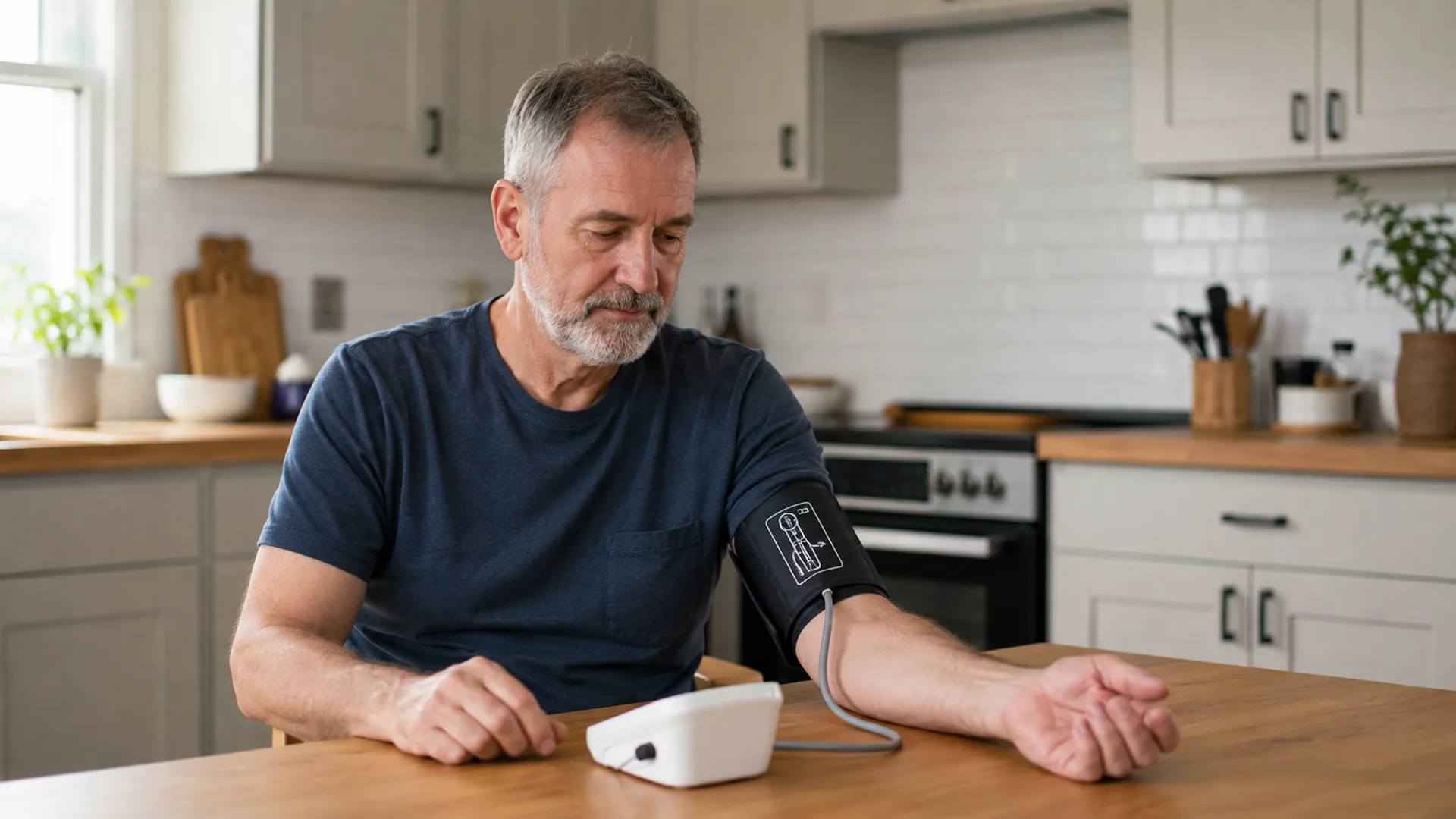
Heart Health
Why Blood Pressure Is Often Higher in the Morning
Blood pressure follows a 24-hour rhythm. For many people it falls during sleep, then rises around waking as the nervous system and hormones prepare the body for activity.
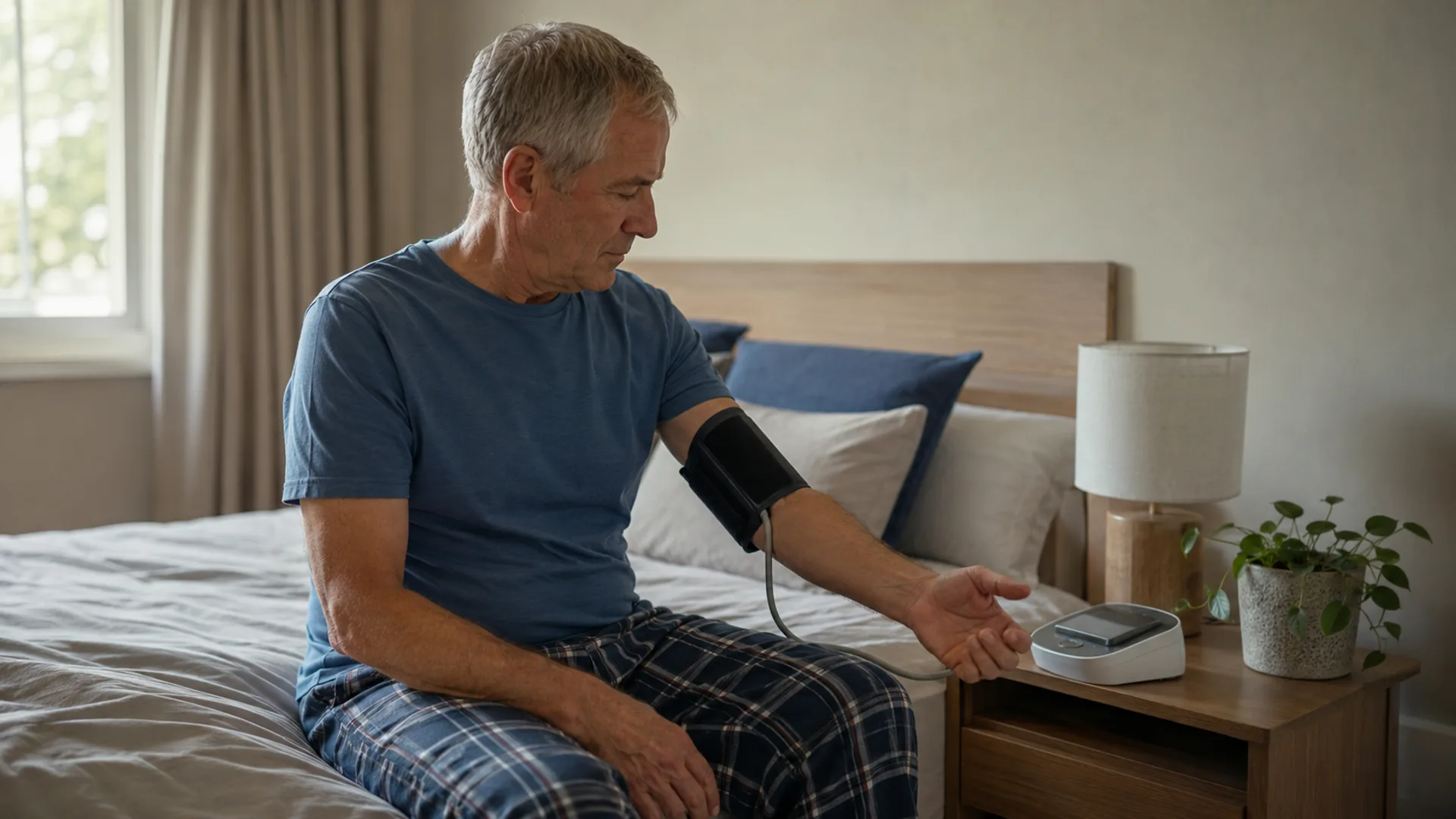
You check your blood pressure at night:
124 / 76
Then the next morning:
141 / 83
Same person. Same cuff.
Why the difference?
Because blood pressure is not supposed to remain perfectly constant.
Blood pressure has a daily rhythm
In many healthy people, pressure falls during sleep by roughly:
10–20%
compared with daytime levels.
Then around waking, pressure begins to rise.
Several systems contribute:
- sympathetic nervous-system activity increases
- epinephrine and norepinephrine rise
- cortisol follows its morning rhythm
- the renin-angiotensin system regulates vascular tone and fluid balance
- you stand up and begin moving
Your body is transitioning from sleep to activity.
Some morning rise is normal.
The concern is repeated high morning pressure
The more useful question is not:
Why is my morning reading higher?
It is:
Is it consistently too high?
The HONEST study followed more than 21,000 treated adults with hypertension.
People with high morning home systolic pressure had substantially greater cardiovascular risk than people whose morning pressure was lower.
Morning home readings also added information beyond clinic blood pressure.
Nighttime “dipping” matters
Many people experience the normal nighttime fall in blood pressure.
Others are:
- non-dippers — pressure falls less than expected
- reverse dippers — pressure rises at night
These patterns have been associated with greater cardiovascular risk.
Possible contributors include:
- sleep apnea
- kidney disease
- autonomic dysfunction
- certain medications
A 24-hour ambulatory blood-pressure monitor can detect these patterns.
What about the “morning surge”?
Researchers have studied how sharply pressure rises between sleep and waking.
Some studies associate a larger surge with stroke and cardiovascular risk.
But there is no single universally accepted cutoff, and studies use multiple definitions.
A systematic review found that, when morning surge was treated as a continuous measure, each additional 10 mmHg was associated with higher stroke risk.
That does not mean you should calculate your own surge from two random readings.
The broader 24-hour pattern matters more.
Sleep apnea deserves attention
Repeated airway obstruction during sleep can trigger:
- oxygen drops
- sympathetic activation
- brief arousals
- blood-pressure surges
If high morning pressure occurs alongside:
- loud snoring
- gasping
- witnessed breathing pauses
- daytime sleepiness
sleep apnea may be worth evaluating.
Should medication automatically be taken at night?
Not necessarily.
Large randomized evidence has not shown a universal cardiovascular advantage to taking blood-pressure medication at bedtime rather than in the morning.
Medication timing should therefore be individualized rather than changed based on generic internet advice.
Get the research, without the noise.
Practical, sourced writing on blood sugar and metabolic health. One email a week.
One email a week. Unsubscribe any time. See our privacy policy.
Measure morning pressure consistently
For useful readings:
- measure before breakfast
- measure before caffeine
- measure before exercise
- sit quietly for about five minutes
- use a validated upper-arm cuff
- take two readings about a minute apart
Do this over several days rather than reacting to one result.
The Health Facts takeaway
Morning blood pressure can be higher because your body is transitioning from:
sleep
into:
wakefulness and activity.
The concern is not the morning itself.
It is a repeated pattern of high pressure, especially when average home readings are elevated or signs of sleep apnea are present.
Your blood pressure is not one number.
It is a 24-hour pattern.
Sources
- 1. Kario K, et al. Morning Home Blood Pressure and Cardiovascular Events in the HONEST Study. doi:10.1016/j.jacc.2016.01.037
- 2. Hoshide S, et al. Morning and Evening Home Blood Pressure and Cardiovascular Events: J-HOP Study. doi:10.1161/HYPERTENSIONAHA.116.07201
- 3. American Heart Association. Home Blood Pressure Monitoring.
- 4. Sheppard JP, Hodgkinson J, Riley R, Martin U, Bayliss S, McManus RJ. Prognostic Significance of the Morning Blood Pressure Surge in Clinical Practice: A Systematic Review. American Journal of Hypertension, 2015. doi:10.1093/ajh/hpu104
- 5. Mackenzie IS, Rogers A, Poulter NR, et al. Cardiovascular Outcomes in Adults With Hypertension With Evening Versus Morning Dosing of Usual Antihypertensive Drugs in the UK (TIME Study): A Prospective, Randomised, Open-Label, Blinded-Endpoint Clinical Trial. The Lancet, 2022. doi:10.1016/S0140-6736(22)01786-X
Comments
No comments yet.
Leave a comment
Comments are moderated. Be kind and stay on topic.