Healthy Aging
Grip Strength Is Surprisingly Linked to How Well We Age — Here's What Researchers Found
Grip strength is quick to measure but reflects far more than the hand. Large studies link weaker grip with disability, cardiovascular events, and mortality.
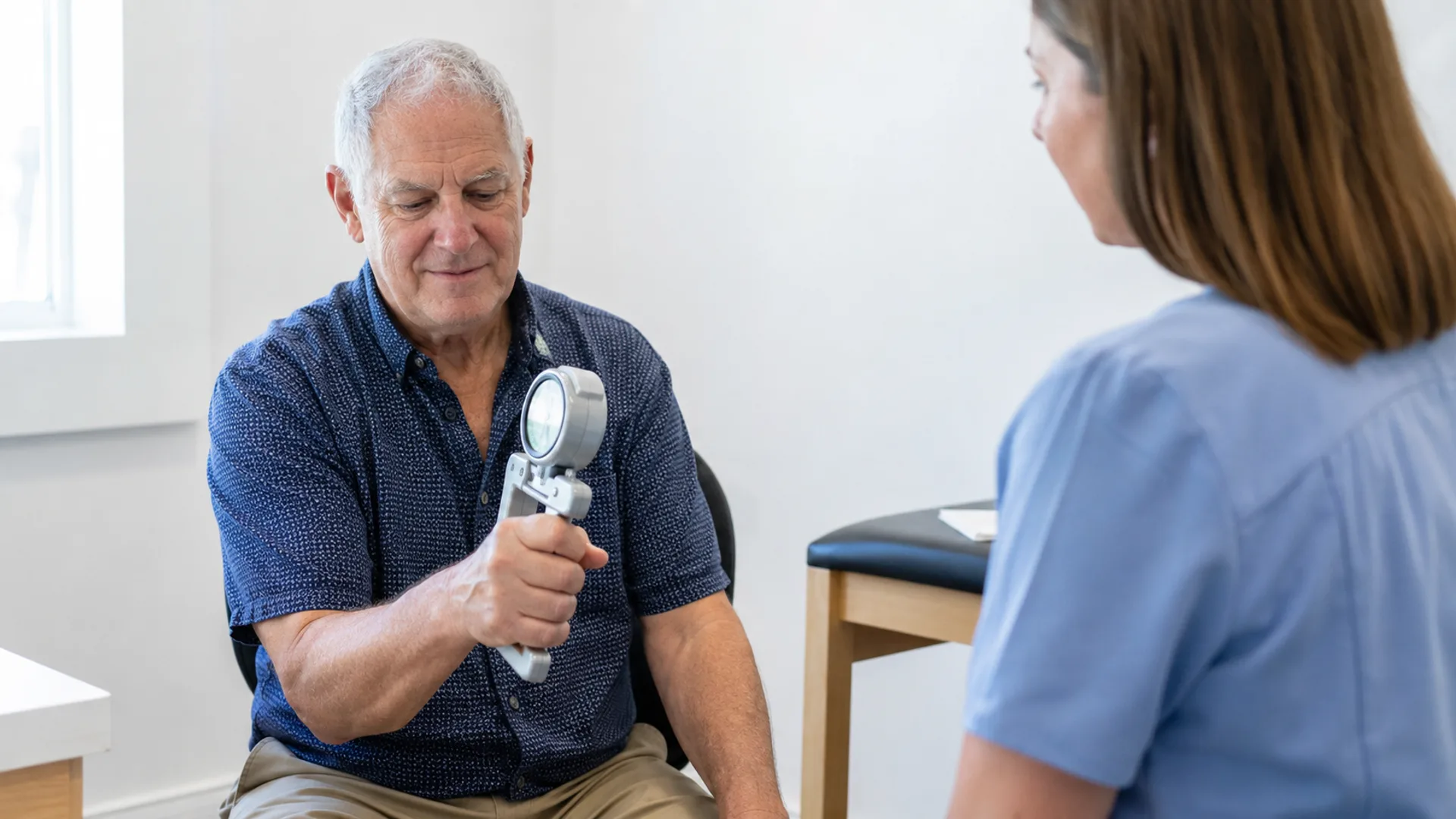
A doctor hands you a device and says:
"Squeeze as hard as you can."
A few seconds later, you have a number.
That number is called:
handgrip strength.
It sounds like a hand test.
But researchers increasingly use it as a quick marker of:
whole-body physical reserve.
The PURE study included nearly 140,000 adults
One of the most important studies measured grip strength in:
139,691 adults
from 17 countries.
For every:
5 kg lower grip strength
researchers observed approximately:
- 16% higher all-cause mortality
- 17% higher cardiovascular mortality
- 7% higher heart-attack risk
- 9% higher stroke risk
after adjustment for several other factors.
In that analysis, grip strength statistically predicted mortality at least as well as several traditional measurements.
That does not mean grip strength is more causally important than blood pressure.
It means one simple strength measurement contains a surprising amount of information about overall health.
Why would your hand predict anything?
Because grip strength is not really just about your fingers.
Producing a strong grip requires:
- muscle
- nerves
- motor control
- nutrition
- physical activity
- intact joints
- overall health
A person with greater whole-body strength tends to have a stronger grip.
A person becoming frail, inactive, or chronically ill may often lose grip strength along with strength elsewhere.
So grip functions like a:
compressed summary of physical reserve.
It peaks earlier than most people realize
Population studies suggest grip strength typically peaks in the:
30s and 40s
then gradually declines.
A British analysis using 12 studies and nearly 50,000 participants created normative grip-strength curves across adulthood.
The point is not to compare yourself obsessively with a chart.
It is to understand that decline can begin long before someone feels “old.”
Midlife grip can predict later function
The Honolulu Heart Program followed more than:
6,000 men
who were middle-aged when grip strength was first measured.
Over decades, weaker grip in midlife was associated with greater later risk of:
- disability
- difficulty walking
- functional limitation
Again, association does not prove weak grip caused the later disability.
It suggests that physical reserve in midlife matters.
Grip strength is part of sarcopenia assessment
The European Working Group on Sarcopenia in Older People places muscle strength at the center of diagnosis.
Common reference cutoffs include approximately:
Men below 27 kg
Women below 16 kg
These values are screening thresholds, not universal definitions of health.
Get the research, without the noise.
Practical, sourced writing on blood sugar and metabolic health. One email a week.
One email a week. Unsubscribe any time. See our privacy policy.
Buying a grip trainer is not the lesson
If grip strength predicts health, it is tempting to conclude:
"Then I should squeeze a grip device all day."
That misses the point.
Grip is valuable largely because it reflects broader strength and function.
Training only the hand may improve the test without meaningfully improving:
- leg strength
- balance
- mobility
- cardiorespiratory fitness
A better strategy is whole-body resistance training.
The Health Facts takeaway
Grip strength is useful because it is:
- cheap
- quick
- objective
- surprisingly informative
But it is not a magical longevity score.
A weak grip does not cause every bad outcome associated with it.
Instead, it often acts as a window into:
the strength and reserve of the person attached to the hand.
That is why maintaining strength across adulthood matters far beyond how much weight you can lift in a gym.
Sources
- 1. Leong DP, et al. Prognostic Value of Grip Strength: Findings From the Prospective Urban Rural Epidemiology (PURE) Study. The Lancet, 2015. doi:10.1016/S0140-6736(14)62000-6
- 2. Dodds RM, et al. Grip Strength Across the Life Course: Normative Data From Twelve British Studies. PLoS ONE, 2014. doi:10.1371/journal.pone.0113637
- 3. Rantanen T, et al. Midlife Hand Grip Strength as a Predictor of Old Age Disability. JAMA, 1999. doi:10.1001/jama.281.6.558
- 4. Cruz-Jentoft AJ, et al. Sarcopenia: Revised European Consensus on Definition and Diagnosis. Age and Ageing, 2019. doi:10.1093/ageing/afz046
Comments
No comments yet.
Leave a comment
Comments are moderated. Be kind and stay on topic.