Healthy Aging
Why Getting Up From the Floor Gets Harder With Age
Rising from the floor is a surprisingly demanding movement that combines strength, power, mobility, balance, coordination, and confidence. Aging can affect all of them at once.
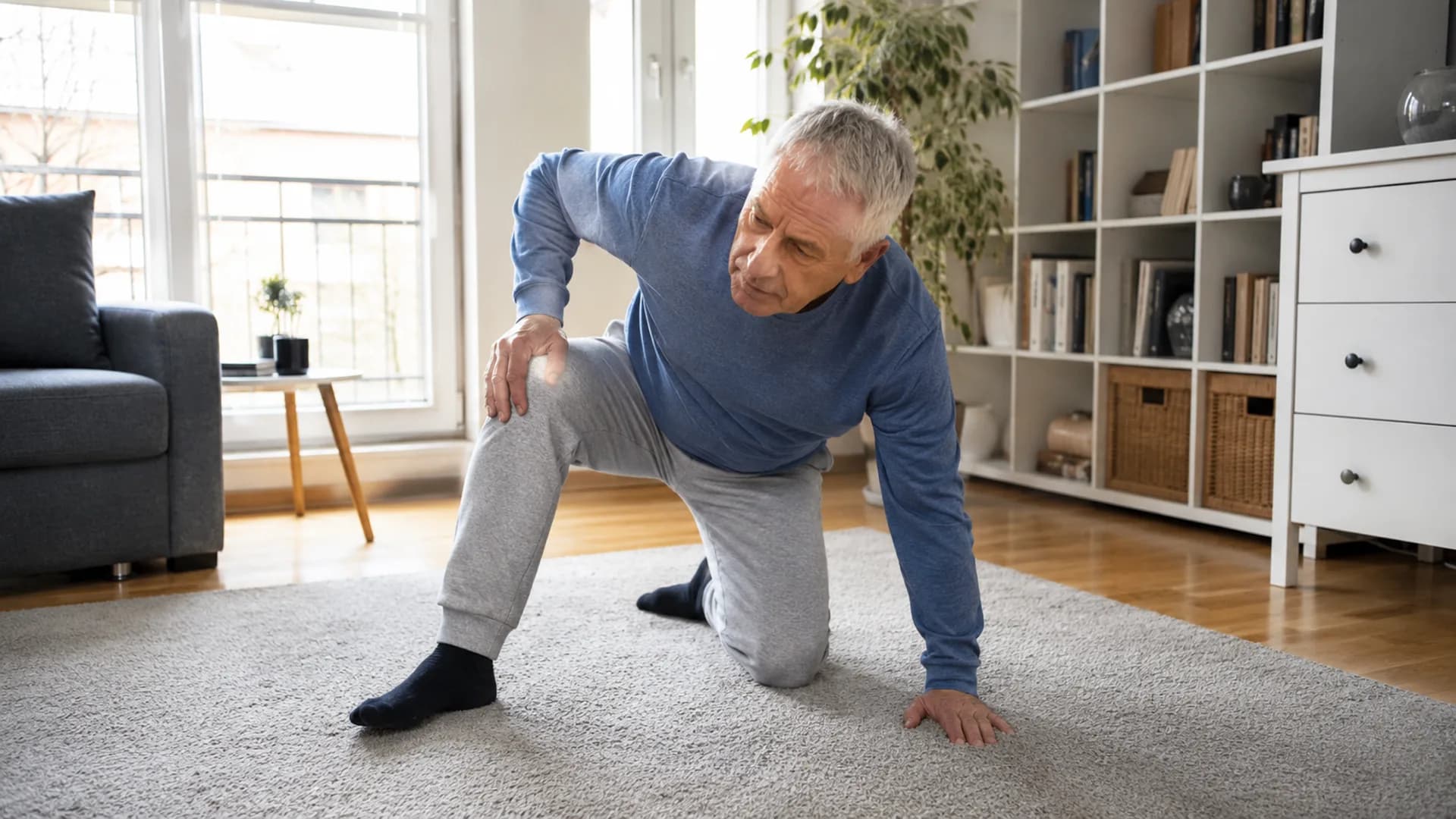
At 25, getting off the floor may require almost no thought.
At 65, the same movement can suddenly feel like a puzzle.
Do you:
- put a hand down?
- roll onto a knee?
- grab the couch?
- push off both thighs?
The difference is not simply “getting old.”
Standing up from the floor is a complex physical task.
A floor rise requires several systems at once
To stand from the floor, you need enough:
- leg strength
- muscle power
- hip mobility
- knee mobility
- ankle mobility
- balance
- coordination
You also need to move your entire body mass vertically from near floor level to standing.
That makes a floor transfer much more demanding than getting out of a normal chair.
Strength is only part of it
The quadriceps and gluteal muscles are obvious contributors.
But power matters too.
Power is the ability to produce force quickly.
As we age, power can decline faster than maximal strength.
That matters when you need to:
- catch yourself
- climb stairs quickly
- rise from a low surface
- recover from a stumble
A person can have enough strength to complete a movement slowly but not enough power to do it efficiently.
Mobility can become the limiting factor
A common floor-rise strategy involves moving through:
half-kneeling.
That requires substantial movement from the:
- hips
- knees
- ankles
Arthritis, stiffness, pain, and reduced ankle dorsiflexion can make the movement awkward even when muscle strength is adequate.
Balance matters the entire time
Rising from the floor changes your center of mass dramatically.
The nervous system must integrate information from:
- vision
- the vestibular system
- proprioception
If balance feels uncertain, you may instinctively add hand support.
That is not cheating.
It is a compensation strategy.
Fear can create its own decline
Suppose getting off the floor becomes slightly difficult.
You stop sitting on the floor.
Then you stop practicing the movement.
Months become years.
Now it feels even less familiar.
The cycle becomes:
difficulty
↓
avoidance
↓
less practice
↓
greater difficulty
Movement skill is partly maintained by using it.
Floor-rise ability has been associated with health outcomes
Observational studies have linked poorer sitting-rising or floor-transfer ability with:
- disability
- poorer physical function
- falls
- mortality
One frequently cited sitting-rising study followed adults age 51–80 and found lower scores were associated with worse survival.
That does not prove practicing floor rises extends life.
The test likely captures multiple dimensions of physical reserve at once.
Using your hands does not mean you are unhealthy
A person with:
- knee arthritis
- previous joint replacement
- long legs
- pain
may sensibly use a hand.
The useful question is whether your strategy is becoming:
more dependent over time.
Get the research, without the noise.
Practical, sourced writing on blood sugar and metabolic health. One email a week.
One email a week. Unsubscribe any time. See our privacy policy.
Can you improve it?
Usually, yes.
Training can address the components:
Strength
- squats
- sit-to-stands
- step-ups
Power
- faster controlled chair rises
Mobility
- hip and ankle mobility work
Balance
- progressively challenging standing tasks
Skill
- practicing safe floor transfers
The Health Facts takeaway
Getting up from the floor is difficult because it compresses many abilities into one task.
You need:
strength + power + mobility + balance + coordination
at the same time.
The solution is not to obsess over whether you can stand without using your hands.
It is to preserve the ingredients that keep floor transfers possible.
Sources
- 1. Cruz-Jentoft AJ, et al. Sarcopenia: Revised European Consensus on Definition and Diagnosis. Age and Ageing, 2019. doi:10.1093/ageing/afz046
- 2. Brito LBB, et al. Ability to Sit and Rise From the Floor as a Predictor of All-Cause Mortality. European Journal of Preventive Cardiology, 2014. doi:10.1177/2047487312471759
- 3. Guralnik JM, et al. A Short Physical Performance Battery Assessing Lower Extremity Function: Association With Self-Reported Disability and Prediction of Mortality and Nursing Home Admission. Journal of Gerontology, 1994. doi:10.1093/geronj/49.2.M85
- 4. Reid KF, Fielding RA. Skeletal Muscle Power: A Critical Determinant of Physical Functioning in Older Adults. Exercise and Sport Sciences Reviews, 2012. doi:10.1097/JES.0b013e31823b5f13
Comments
No comments yet.
Leave a comment
Comments are moderated. Be kind and stay on topic.