Sleep & Stress
How Much Sleep Do Adults Over 50 Actually Need?
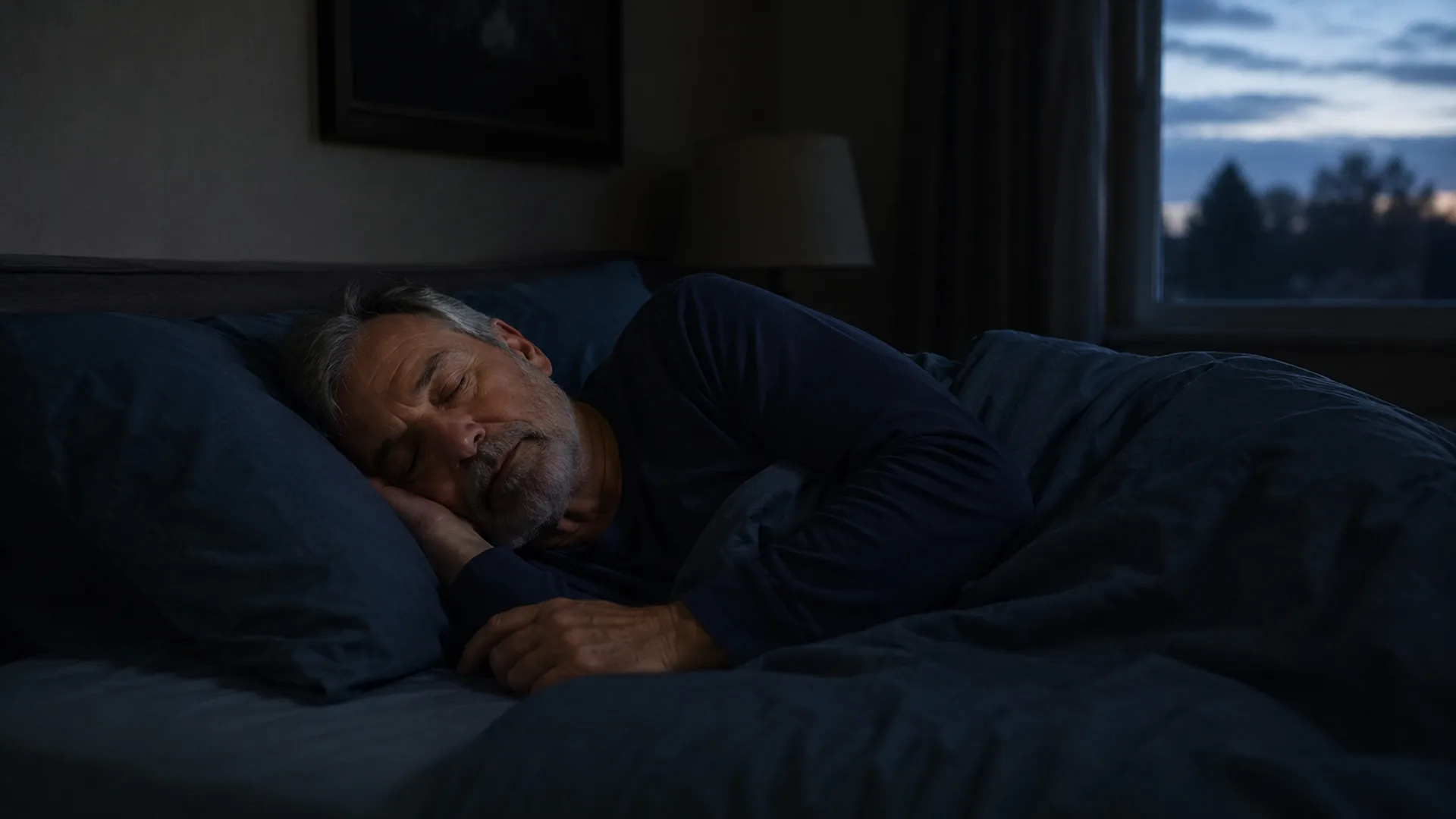
Older adults often sleep differently, but that does not necessarily mean they need less sleep. Most still need roughly seven to nine hours.
Many people assume:
"I'm older now. I probably don't need eight hours anymore."
But sleeping less with age is not necessarily the same thing as:
needing less sleep.
The National Institute on Aging says older adults generally need about:
7–9 hours per night.
The American Academy of Sleep Medicine recommends that healthy adults regularly obtain at least:
7 hours.
Why older adults often sleep less anyway
Aging changes sleep architecture.
Compared with younger adults, older people generally experience:
- less slow-wave sleep
- more nighttime awakenings
- more fragmented sleep
- lower sleep efficiency
So someone may need seven or eight hours but have greater difficulty obtaining them continuously.
Time in bed is not the same as time asleep
Two people can both spend eight hours in bed.
One sleeps 7 hours 40 minutes.
The other sleeps 5 hours 50 minutes.
Same bedtime.
Very different sleep duration.
This is why sleep efficiency — the percentage of time in bed actually spent asleep — can be useful.
Quality matters too
Someone with untreated sleep apnea may spend eight hours sleeping but experience repeated breathing interruptions and arousals.
They may wake exhausted.
Another person can sleep 7½ hours continuously and feel refreshed.
Healthy sleep includes:
- duration
- continuity
- regularity
- appropriate timing
- absence of untreated sleep disorders
But duration still matters
“Quality matters” should not be turned into:
"Then six hours of really good sleep is enough."
Habitual sleep below seven hours is associated with poorer health outcomes in many large studies.
These include higher rates of:
- cardiovascular disease
- obesity
- depression
- accidents
- impaired performance
Most of those data are observational.
The concern is chronic short sleep, not one rough night.
Six hours can feel normal because you've adapted to it
Some people really are naturally short sleepers.
They appear to be uncommon.
More often, people become accustomed to insufficient sleep and stop recognizing how impaired they feel.
Clues that you may need more include:
- sleeping much longer on weekends
- relying heavily on caffeine
- struggling to wake without several alarms
- dozing during quiet activities
- feeling dramatically better after several longer nights
Midlife sleep has been linked with later brain health
The Whitehall II cohort followed nearly:
8,000 adults
for decades.
Short sleep — around six hours or less — at ages 50 and 60 was associated with higher later dementia risk compared with around seven hours.
Persistent short sleep across midlife and later life was associated with roughly:
30% higher dementia risk.
This does not prove sleep loss caused dementia.
Long-term observational studies cannot fully rule out reverse causation or confounding.
But the findings argue against dismissing chronic short sleep in midlife as harmless.
More is not always better either
Large cohort studies often show a:
U-shaped relationship
where both very short and very long sleep are associated with higher mortality.
But long sleep can be a symptom of:
- chronic illness
- depression
- frailty
- sleep disorders
rather than the cause.
Sleeping nine hours after a week of sleep deprivation is not the same as suddenly requiring 11–12 hours every day while remaining exhausted.
Get the research, without the noise.
Practical, sourced writing on blood sugar and metabolic health. One email a week.
One email a week. Unsubscribe any time. See our privacy policy.
Your body clock may shift earlier
Older adults often become earlier sleepers and earlier risers.
That can be a normal circadian shift rather than insomnia.
The important question is not whether your schedule matches what you did at 30.
It is whether you obtain enough restorative sleep at a schedule that fits your biology.
The Health Facts takeaway
For most adults over 50, a reasonable evidence-based target remains:
7–9 hours.
Aging often changes:
how easily you sleep
more than it changes:
whether you need sleep.
So regularly living on five or six hours should not automatically be accepted as:
"That's just aging."
At the same time, exactly eight hours is not a biological law.
Look at:
- total sleep
- daytime alertness
- consistency
- sleep disorders
- how you function
rather than chasing one perfect number.
Sources
- 1. National Institute on Aging. Sleep and Older Adults.
- 2. Watson NF, et al. Recommended Amount of Sleep for a Healthy Adult: A Joint Consensus Statement of the American Academy of Sleep Medicine and Sleep Research Society. Journal of Clinical Sleep Medicine, 2015. doi:10.5664/jcsm.4758
- 3. Hirshkowitz M, et al. National Sleep Foundation's Sleep Time Duration Recommendations: Methodology and Results Summary. Sleep Health, 2015. doi:10.1016/j.sleh.2014.12.010
- 4. Sabia S, et al. Association of Sleep Duration in Middle and Old Age With Incidence of Dementia. Nature Communications, 2021. doi:10.1038/s41467-021-22354-2
- 5. Li J, Vitiello MV, Gooneratne NS. Sleep in Normal Aging. Sleep Medicine Clinics, 2022. doi:10.1016/j.jsmc.2022.02.007
Comments
No comments yet.
Leave a comment
Comments are moderated. Be kind and stay on topic.