Sleep & Stress
Snoring vs. Sleep Apnea: When Is Snoring More Than Just Annoying?
Snoring is common and does not automatically mean sleep apnea. But loud snoring with breathing pauses, gasping, or daytime sleepiness can signal airway collapse during sleep.
Snoring is noise.
Sleep apnea is:
breathing repeatedly becoming inadequate during sleep.
The two can occur together, but they are not the same thing.
What causes snoring?
During sleep, muscles in the upper airway relax.
The airway becomes narrower.
As air moves through, tissues can vibrate:
- soft palate
- uvula
- tongue
- throat walls
That vibration produces:
snoring.
Someone can snore while still moving enough air.
That is often called primary snoring.
What changes in obstructive sleep apnea?
In obstructive sleep apnea — OSA — the airway repeatedly becomes:
partially or completely blocked.
The chest may continue trying to breathe, but airflow falls sharply or stops.
Eventually the brain briefly increases arousal.
The airway reopens.
Breathing resumes.
The person may:
- gasp
- choke
- snort
then return to sleep without remembering it.
The AHI counts breathing events
Sleep studies often report:
Apnea-Hypopnea Index — AHI
which counts breathing events per hour of sleep.
Common adult categories are:
- below 5: normal range
- 5 to <15: mild OSA
- 15 to <30: moderate
- 30 or more: severe
An AHI of 30 means an average of one breathing disturbance roughly every:
two minutes.
AHI is useful, but it is not the whole story.
Oxygen drops, event duration, sleep fragmentation, and symptoms also matter.
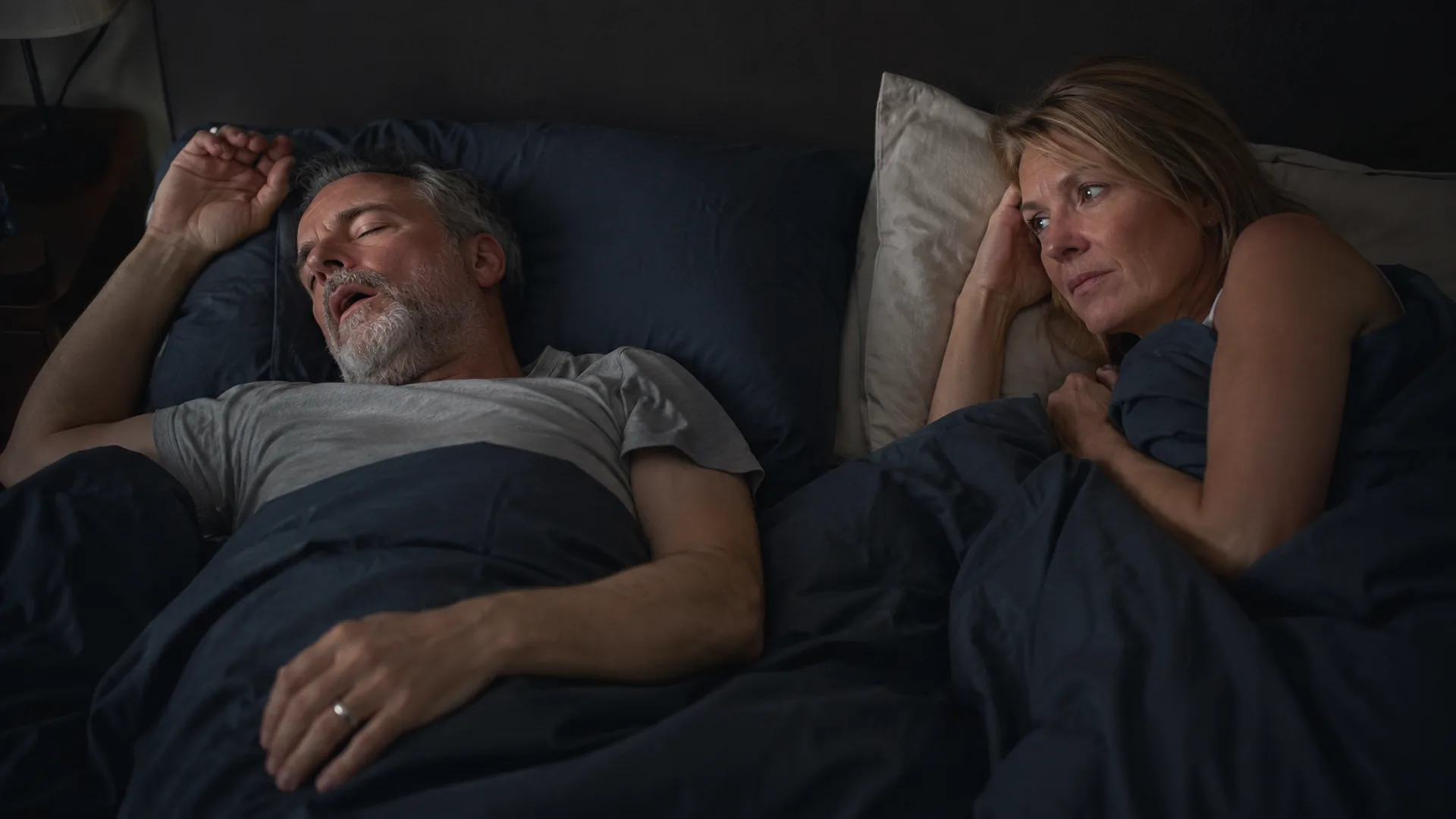
The most concerning clue may come from your partner
Steady snoring is one thing.
This pattern is different:
snoring
↓
silence
↓
no obvious breathing
↓
gasp
↓
snoring resumes
Witnessed breathing pauses strongly raise suspicion for sleep apnea.
Other warning signs
OSA becomes more likely when snoring occurs with:
- gasping or choking
- severe daytime sleepiness
- unrefreshing sleep
- morning headaches
- frequent nighttime urination
- hypertension
Not everyone with OSA feels obviously sleepy.
Some people report:
- insomnia
- fatigue
- concentration problems
instead.
Women may also present with less stereotypical symptoms, particularly after menopause.
Weight matters — but thin people can have OSA
Excess body fat can increase airway collapsibility and is an important risk factor.
But airway anatomy also matters:
- jaw structure
- tongue size
- neck anatomy
- tonsils
- genetics
So being thin does not rule out sleep apnea.
Alcohol and sleeping position can worsen it
Alcohol relaxes upper-airway muscles and can worsen snoring and apnea.
Sleeping on the back can also increase airway collapse in some people.
That is called:
positional sleep apnea.
Get the research, without the noise.
Practical, sourced writing on blood sugar and metabolic health. One email a week.
One email a week. Unsubscribe any time. See our privacy policy.
Snoring volume does not tell you severity
A very loud snorer may not have severe OSA.
Someone with significant airway obstruction may make relatively little noise.
During a complete apnea there may be:
silence
because airflow has stopped.
Phone apps can therefore provide clues, but they cannot diagnose OSA.
How is sleep apnea diagnosed?
The most complete test is:
polysomnography
in a sleep laboratory.
Selected adults can be tested with a:
home sleep apnea test.
Home tests usually measure fewer signals and can sometimes underestimate disease.
If a home test is negative but clinical suspicion remains high, guidelines recommend further evaluation.
The Health Facts takeaway
Snoring becomes more concerning when it is not simply:
continuous noise.
The important pattern is:
snoring + breathing pauses + gasping + sleepiness or other symptoms.
If your partner says:
"You snore."
that's information.
If they say:
"You stop breathing."
that's different information entirely.
Sources
- 1. Kapur VK, et al. Clinical Practice Guideline for Diagnostic Testing for Adult Obstructive Sleep Apnea: An American Academy of Sleep Medicine Clinical Practice Guideline. Journal of Clinical Sleep Medicine, 2017. doi:10.5664/jcsm.6506
- 2. National Heart, Lung, and Blood Institute. Sleep Apnea.
- 3. U.S. Preventive Services Task Force. Screening for Obstructive Sleep Apnea in Adults: US Preventive Services Task Force Recommendation Statement. JAMA, 2022. doi:10.1001/jama.2022.20304
- 4. Malhotra A, et al. Metrics of Sleep Apnea Severity: Beyond the Apnea-Hypopnea Index. Sleep, 2021. doi:10.1093/sleep/zsab030
Comments
No comments yet.
Leave a comment
Comments are moderated. Be kind and stay on topic.