Blood Sugar
Why Morning Blood Sugar Can Be High Even When You Haven't Eaten Anything
You haven't eaten all night, yet your glucose is higher when you wake up. The explanation has less to do with breakfast than with your liver and early-morning hormones.

You finish dinner at 7 p.m.
You don't snack.
You sleep for eight hours.
Then you check your glucose in the morning...
and somehow it's higher.
That seems backwards.
If you haven't eaten, where did the sugar come from?
The answer is important:
Not all glucose in your bloodstream comes directly from food.
Your liver can make and release glucose on its own.
And in the early morning, your body may actually tell it to do exactly that.
Your liver keeps supplying glucose while you sleep
Even when you're fasting, your body still needs energy.
Your brain, red blood cells, and other tissues continue using fuel throughout the night.
So your liver helps maintain blood glucose in two main ways:
- Glycogenolysis: breaking down stored glycogen into glucose
- Gluconeogenesis: making new glucose from other compounds
This is normal physiology.
Without it, blood glucose could fall too low every time you went several hours without eating.
The problem in type 2 diabetes and insulin resistance isn't that the liver makes glucose.
It's that the liver may release more than is needed — or fail to slow production appropriately when insulin signals it to stop.
As we explained in Insulin Resistance Isn't Just One Thing, one of insulin's normal jobs is to tell the liver:
We have enough glucose. Slow down production.
When the liver becomes insulin resistant, that message may not work as effectively.
Then early-morning hormones enter the picture
During the hours before waking, the body begins preparing for the day ahead.
Hormones associated with the body's circadian rhythm start changing.
These include:
- cortisol
- growth hormone
- glucagon
- epinephrine
These are sometimes called counter-regulatory hormones because their effects can oppose insulin and help make more fuel available.
One of their effects is to encourage the liver to release glucose.
In someone with normal glucose regulation, the pancreas responds with enough insulin to keep glucose relatively stable.
But if insulin production is insufficient — or the body is resistant to insulin — the increase in liver glucose can become more noticeable.
The result:
blood sugar rises before breakfast even exists.
This is known as the dawn phenomenon.
When does the dawn phenomenon happen?
The exact timing varies, but the rise typically occurs in the early morning hours.
The American Diabetes Association and Mayo Clinic commonly describe it as occurring approximately between:
4 a.m. and 8 a.m.
That doesn't mean glucose suddenly jumps at exactly 4:00.
The process is gradual and influenced by:
- circadian rhythm
- hormone secretion
- insulin sensitivity
- medications
- sleep schedule
- individual physiology
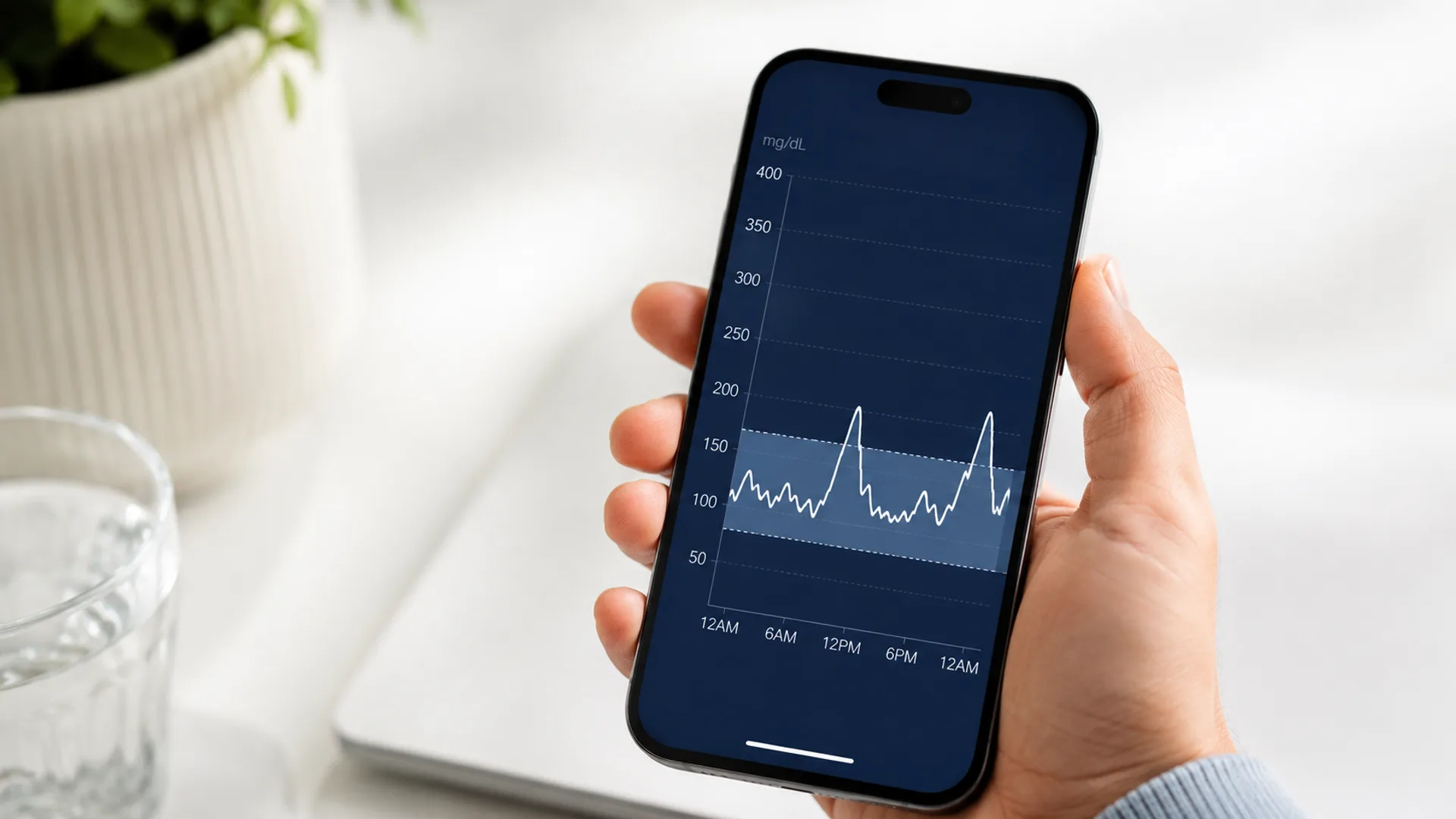
Continuous glucose monitors make this easier to see.
A person may have relatively steady glucose through much of the night...
then see it begin climbing several hours before waking.
This isn't unique to people with diabetes
Here's an interesting detail.
Researchers have observed dawn-like changes even in people without diabetes.
In one classic study, healthy volunteers experienced increases in glucose production and insulin secretion in the pre-waking hours.
Their bodies simply produced enough additional insulin to prevent significant hyperglycemia.
So the early-morning hormonal shift itself isn't necessarily abnormal.
The difference is how well your body compensates for it.
A useful way to think about a fasting glucose reading
The dawn phenomenon answers a question that confuses many people who fast:
"If I'm not eating, why is my glucose going up?"
The explanation is that the body is moving stored energy into circulation.
That's an extremely useful way to think about it.
A fasting glucose reading doesn't tell you:
"How much sugar did I just eat?"
It tells you:
"How much glucose is currently circulating in my bloodstream?"
That glucose can come from food.
But it can also come from your own liver.
This distinction matters because otherwise people often blame the previous night's meal for every elevated morning number.
Sometimes dinner matters.
Sometimes it doesn't explain the entire story.
Fasting longer doesn't guarantee glucose will keep falling
This is another counterintuitive part.
People sometimes expect:
"If 8 hours without food lowers glucose, then 12 or 16 hours should lower it even more."
Not necessarily.
During fasting, insulin generally falls and hormones such as glucagon help maintain access to stored energy.
The liver can continue releasing glucose to ensure that tissues have fuel available.
Some people may therefore see something like:
6:00 a.m. — 140 mg/dL
and then:
10:00 a.m. — 105 mg/dL
despite eating nothing in between.
The early-morning hormonal surge has passed.
Insulin sensitivity and glucose production have changed.
The glucose falls.
That pattern can be very different from persistent hyperglycemia throughout the entire night and morning.
Not every morning high is the dawn phenomenon
This is important.
There are several possible reasons for elevated morning glucose.
Dawn phenomenon
Glucose is relatively lower overnight and then rises in the hours before waking.
Not enough medication overnight
For someone using insulin or glucose-lowering medication, the effect may wear off before morning.
Glucose can therefore rise overnight.
Carbohydrates late at night
A substantial bedtime snack or late meal may contribute to elevated overnight and morning glucose.
Persistent overnight hyperglycemia
Sometimes glucose isn't specifically rising at dawn.
It was simply elevated for much of the night.
That's a different pattern.
Nocturnal hypoglycemia — possibly
You may have heard of the Somogyi effect.
The theory is that glucose drops too low overnight, triggering counter-regulatory hormones that then cause rebound high glucose in the morning.
This idea has been taught for decades.
But modern CGM studies suggest that true rebound hyperglycemia after overnight hypoglycemia is much less common than once believed.
In one study of people with type 1 diabetes, morning glucose was actually lower — not higher — following nights with hypoglycemia.
A large CGM analysis involving people with type 2 diabetes treated with insulin also found little support for the classic Somogyi explanation.
The ADA now describes it as a much rarer cause of morning highs than the dawn phenomenon or insufficient overnight insulin.
The easiest way to distinguish the patterns is to look overnight
One fasting glucose reading can't tell you what happened during the previous eight hours.
If morning glucose is consistently high, a clinician may look at:
- bedtime glucose
- middle-of-the-night glucose
- waking glucose
- CGM data
For example:
Pattern A
10 p.m.: 105
3 a.m.: 95
7 a.m.: 135
That pattern is consistent with an early-morning rise.
Pattern B
10 p.m.: 170
3 a.m.: 165
7 a.m.: 180
That's less suggestive of a distinct dawn phenomenon.
Glucose was elevated all night.
Pattern C
10 p.m.: 110
3 a.m.: 55
7 a.m.: 160
That would raise concern about overnight hypoglycemia and requires clinical attention, particularly in someone using insulin or medications that can cause low glucose.
The pattern often tells you much more than the final morning number.
Does the dawn phenomenon actually matter?
An occasional slightly higher morning reading is not necessarily a major problem.
But when the dawn rise happens consistently, it can meaningfully affect overall glucose exposure.
In one continuous-glucose-monitoring study of 248 people with type 2 diabetes, researchers found a median early-morning glucose increase of about 16 mg/dL.
The estimated effect on A1C was approximately 0.4 percentage points.
So someone whose overall glucose control might otherwise produce an A1C around 6.6% could theoretically end up closer to 7.0% if a persistent dawn rise contributes enough additional glucose exposure.
That doesn't happen identically in everyone.
But it shows why morning glucose isn't always just a meaningless quirk.
Get the research, without the noise.
Practical, sourced writing on blood sugar and metabolic health. One email a week.
One email a week. Unsubscribe any time. See our privacy policy.
What can influence morning glucose?
Several lifestyle factors may affect overnight and morning glucose indirectly, including:
- evening meal size
- carbohydrate quantity and quality
- late-night eating
- physical activity
- sleep duration
- stress
- alcohol
- medication timing
But there is no single universal "dawn phenomenon diet."
And people taking insulin or glucose-lowering medications should not change medication doses or start aggressive fasting based solely on an article or one glucose reading.
Morning hyperglycemia can have different causes.
The appropriate response depends on the pattern.
The Health Facts takeaway
High morning glucose can feel irrational:
"I haven't eaten anything. Why is my sugar higher?"
But glucose isn't only something you put into your body.
It's also something your body stores, produces, and releases.
In the early morning:
hormones rise
↓
the liver releases more glucose
↓
insulin is supposed to keep that glucose controlled
If your pancreas cannot produce enough insulin — or your liver and other tissues are resistant to insulin — glucose may rise more than it should.
That's the dawn phenomenon.
And it reveals something important about metabolic health:
Blood sugar isn't just about what you eat.
It's also about how well your body manages fuel between meals.
A metabolically flexible system should be able to:
- store energy after eating
- release energy when food isn't available
- prevent glucose from rising excessively
- switch between stored and incoming fuels appropriately
Morning glucose gives you one small window into that larger system.
So if your fasting number is unexpectedly high, don't immediately conclude:
"I ate something wrong."
Sometimes the more useful question is:
"What was my body doing overnight?"
Sources
- 1. High Morning Blood Glucose: Understanding and Management. American Diabetes Association.
- 2. The Dawn Phenomenon: What Can You Do?. Mayo Clinic.
- 3. The Dawn Phenomenon in Diabetes: Pathophysiology From Periphery to Central Nervous System and Circadian Rhythm-Based Therapeutic Strategies. Acta Diabetologica, 2026. doi:10.1007/s00592-026-02763-9
- 4. Magnitude of the Dawn Phenomenon and Its Impact on the Overall Glucose Exposure in Type 2 Diabetes. Diabetes Care (American Diabetes Association), 2013. doi:10.2337/dc12-2127
- 5. Porcellati F, Lucidi P, Bolli GB, Fanelli CG. Thirty Years of Research on the Dawn Phenomenon: Lessons to Optimize Blood Glucose Control in Diabetes. Diabetes Care (American Diabetes Association), 2013. doi:10.2337/dc13-2088
- 6. Schmidt MI, Hadji-Georgopoulos A, Rendell M, Margolis S, Kowarski A. The Dawn Phenomenon, an Early Morning Glucose Rise: Implications for Diabetic Intraday Blood Glucose Variation. Diabetes Care (American Diabetes Association), 1981.
- 7. Bolli GB, De Feo P, De Cosmo S, et al. Demonstration of a Dawn Phenomenon in Normal Human Volunteers. Diabetes (American Diabetes Association), 1984. doi:10.2337/diab.33.12.1150
- 8. Do High Fasting Glucose Levels Suggest Nocturnal Hypoglycaemia? The Somogyi Effect—More Fiction Than Fact?. Diabetic Medicine, 2013. doi:10.1111/dme.12175
Comments
No comments yet.
Leave a comment
Comments are moderated. Be kind and stay on topic.